The Obama Presidential Center, a high-profile cultural and historical site in Chicago, is currently facing a wave of criticism over its policy requiring visitors to show identification proving Illinois residency to gain free admission. This policy has sparked heated debates on social media, on news platforms, and among political commentators, who argue it contradicts the Democratic Party’s longstanding position against strict voter ID laws.
Since opening its doors to limited visitors, the Center has implemented a policy that grants free entry to Illinois residents upon presentation of a valid state ID. Those without ID must pay the general admission fee. While the Center says the measure is designed to prioritize Illinois residents for the free access benefit, critics see a glaring inconsistency.
“The Obama Presidential Library is making people show an ID for proof of Illinois residency to get in for free so residents have to prove who they are for this, but not to vote?” one social media critic wrote, encapsulating the argument being echoed across platforms. This comment refers explicitly to Democratic efforts nationwide aimed at opposing strict voter ID laws — legislation critics deem as restrictive and disproportionally affecting minority communities.
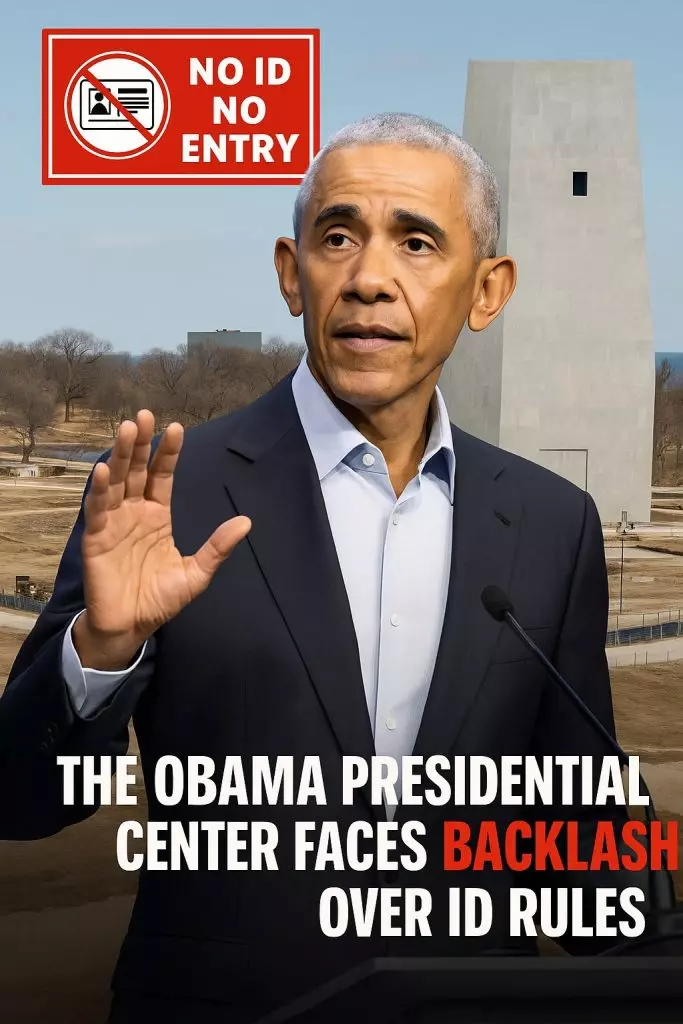
The backlash recently intensified after Fox News aired segments under headlines like “NO ID, NO ENTRY,” visualizing the debate with images of the Oval Office and superimposed text mimicking protest signs. Conservatives have leveraged this to underscore what they suggest is a double standard: Democrats campaigning vigorously against voter ID requirements at the ballot box while enforcing similar ID checks for free admission to a Democratic landmark.
Supporters of the Obama Presidential Center’s policy offer a different perspective. Representatives from the Center argue that requiring identification to confirm residency is a common practice in many publicly funded museums and libraries that have discounted or free admission policies aimed at local residents. The rationale is to use limited resources to primarily benefit the community that supports the institution through taxes.
They also emphasize that admission without free access remains open to all visitors, so there is no actual prohibition on entry without ID—only a fee difference. In contrast, they note, voter ID laws restrict fundamental democratic participation and are subject to legal and ethical scrutiny very different from museum access policies.
Political analysts weigh in by highlighting the nuance in both policies. While voter ID laws affect voting rights, a core pillar of democracy, museum admission fees—though impactful socially—do not carry the same weight. Yet, the optics of the situation create a potent political argument that opponents of the Democratic Party have seized with vigor.
As the debate continues, the Obama Presidential Center finds itself at the intersection of cultural preservation, political symbolism, and the broader national discourse on identification policies. The conversation raises deeper questions about identity, access, and what consistency looks like in public policy. Whether the Center will adjust its policy or reaffirm its current stance remains to be seen, but the controversy highlights how even seemingly administrative details can become flashpoints in the cultural and political landscape.