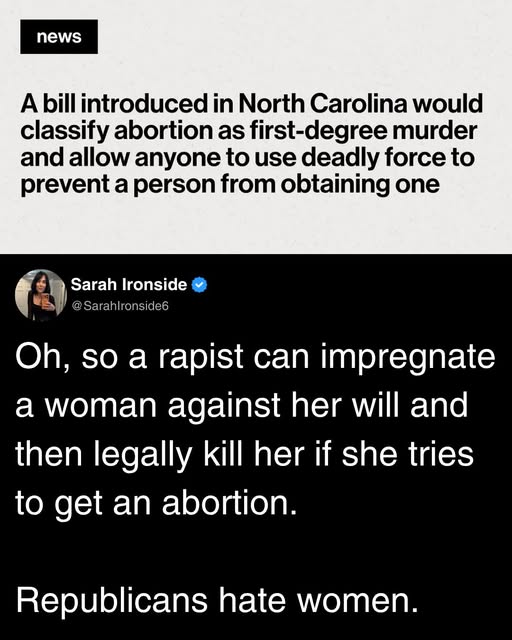
The state of North Carolina is once again at the center of a heated debate over reproductive rights and legislative power, following the recent introduction of a controversial bill that could dramatically reshape the legal landscape surrounding abortion procedures. The proposed legislation would classify abortion as **first-degree murder**, a classification traditionally reserved for the most serious crimes, and would legally permit any individual to use deadly force to prevent a person from obtaining an abortion.
The bill’s text, which has gone viral on social media and sparked widespread outrage and concern, states that abortion providers, women seeking abortions, and potentially even bystanders could be subject to criminal charges under this new framework. Supporters argue that the bill aims to “protect the sanctity of life” and uphold moral values rooted in certain interpretations of religious and cultural beliefs. However, critics sharply oppose what they see as an unprecedented invasion of individual rights and a dangerous loosening of the boundaries around the use of deadly force.
Legal and ethical implications
The implications of classifying abortion as first-degree murder are profound. Under current law, abortion is a regulated medical procedure, with restrictions varying across states. Making it a murder crime elevates it to the most serious felony level, potentially subjecting women and healthcare providers to severe penalties. Furthermore, the bill’s provision allowing civilians to use deadly force to prevent abortions effectively grants legal immunity to vigilante actions, raising serious questions about security, safety, and civil rights.
Legal experts warn that such a measure could escalate violence and put innocent bystanders at risk. “This bill blurs the line between lawful self-defense and extrajudicial violence,” said a constitutional law professor at the University of North Carolina. “It could lead to a dangerous environment where disputes about reproductive choices turn into deadly confrontations.”
The bill’s proponents claim it is necessary to protect unborn children and uphold religious freedoms. However, opponents argue that it undermines fundamental rights to privacy, bodily autonomy, and due process. Activists and advocacy groups have scheduled protests across North Carolina and broader national campaigns calling for the bill’s rejection.
In addition to the legal controversy, the bill has ignited political debates about the balance of power between state legislatures, individual rights, and religious freedoms. Lawmakers are divided, with some viewing the bill as a means of advancing pro-life agendas, while others see it as an unconstitutional overreach that could threaten public safety and civil liberties.
As this bill moves through legislative committees, it remains to be seen whether it will gain enough support to become law, or if it will face legal challenges that could halt its passage. Meanwhile, the social media frenzy continues, with hashtags like #StopVigilanteJustice and #ProtectWomen and #ReproductiveRights trending nationwide, emphasizing the high stakes involved.
Where to Learn More
- North Carolina’s Controversial Abortion Legislation: What You Need to Know – NBC News
- Legal Experts Raise Alarm Over North Carolina Bill Classifying Abortion as Murder – Washington Post
- The Human Rights Perspective: Vigilante Laws and Women’s Rights – Human Rights Watch
- American Civil Liberties Union: Protecting Reproductive Rights