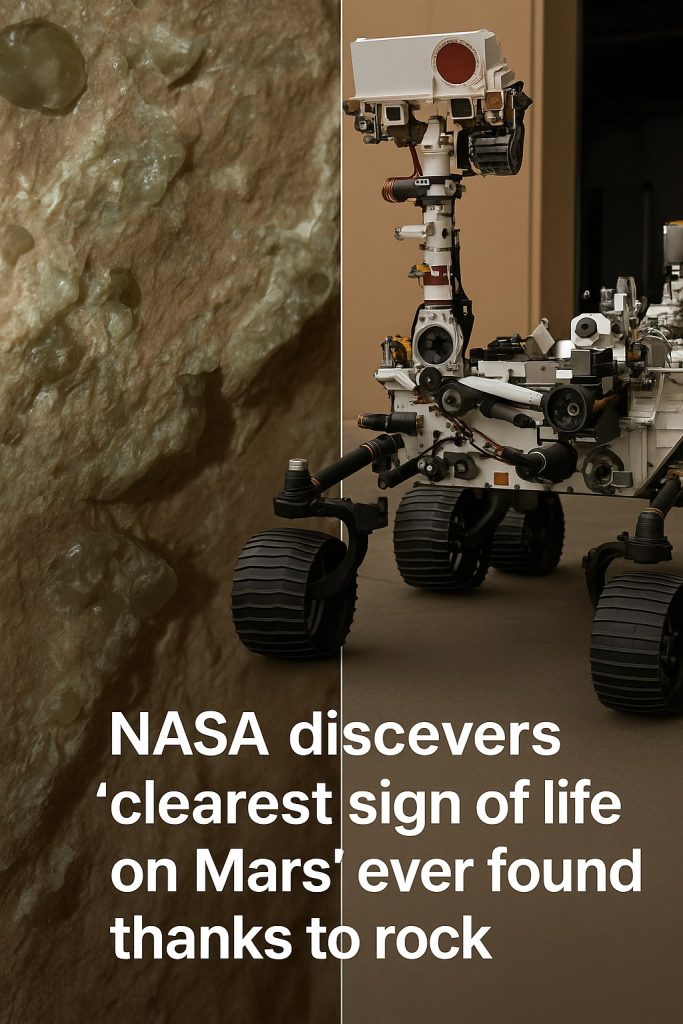
In a groundbreaking announcement that has captured the attention of space enthusiasts and scientists alike, NASA’s Perseverance rover has unearthed new chemical clues on Mars that suggest the planet may have once harbored life. This discovery marks what many are calling the “clearest sign of life on Mars ever found,” sparking excitement in the ongoing quest to understand our neighboring planet’s history and its suitability for sustaining life.
Perseverance, which has been actively exploring the Jezero Crater since its landing in February 2021, has been tasked with seeking signs of ancient microbial life. The mission builds on previous Mars explorations and aims to gather valuable data that could pave the way for future human colonization. The rover’s state-of-the-art instruments, including its sophisticated rock-sampling capabilities, have provided scientists with insights that were previously unattainable.
In a recent update, NASA scientists revealed that the rover had processed rock samples containing organic molecules—essential compounds that form the basis of life as we know it. These findings indicate that the environmental conditions of Mars may have been favorable for life billions of years ago. When combined with previous discoveries of water and essential chemical elements, the potential for past life on Mars grows stronger.
One of the most exciting aspects of this discovery is the ability to identify these organic molecules through the rover’s onboard laboratory. Using its advanced spectroscopy tools, Perseverance analyzed the rock formations and successfully detected specific molecular signatures compatible with biological activity. The clarity and richness of these organic compounds suggest a robust preservation environment, reinforcing theories about Mars’ once-hydrated and habitable nature.
This remarkable finding could alter our understanding of planetary development and the origins of life. “What we’re seeing is not just a hint, but a significant clue that we’re on the right track in our search for ancient life on Mars,” said Dr. Jennifer Trosper, Project Manager of the Perseverance rover at NASA’s Jet Propulsion Laboratory. “As we continue to analyze these samples, we expect to unlock even more mysteries of the Red Planet.”
This discovery has not only rekindled international interest in Martian exploration but has also invigorated discussions about future missions. NASA plans to send more robust tools to return samples to Earth, where they can be further analyzed under more sophisticated conditions. The scientific community is eager to unravel the complex geological history of Mars and determine whether conditions similar to those on Earth existed millions of years ago.
While the findings hold promise, researchers also caution that organic molecules alone do not serve as definitive proof of life. The rigorous scientific process requires further investigation and additional evidence to draw comprehensive conclusions. Nonetheless, the Perseverance rover’s latest achievements bring humanity one step closer to answering the age-old question: Are we alone in the universe?
The concept of life beyond Earth has always captured human imagination, and now, with new tantalizing evidence emerging from Mars, the possibility seems more tangible than ever. As we keep our eyes on the stars, the Perseverance rover continues its mission, reminding us of the unyielding curiosity that drives scientific discovery.
Where to Learn More
- NASA’s Perseverance Rover Detects Organic Molecules on Mars – NASA
- NASA’s Perseverance Rover Has Found the Best Evidence Yet of Ancient Life on Mars – Scientific American
- NASA Perseverance Rover Discovery: Organic Molecules on Mars – Space.com
- Mars’ Perseverance Rover has discovered what could be a sign of ancient life – CNN