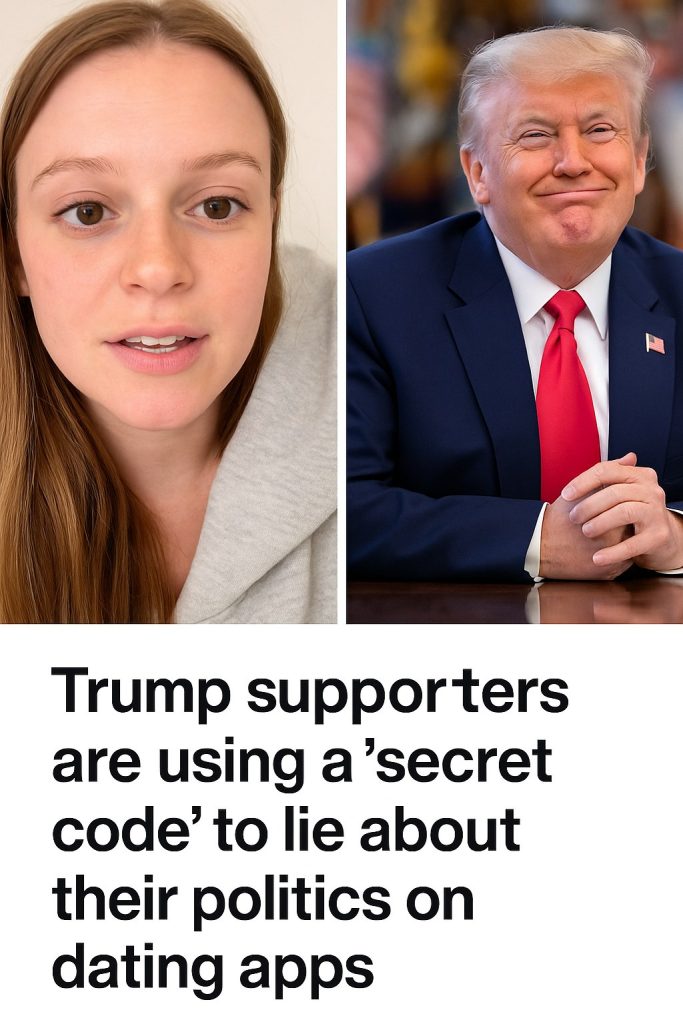
In the run-up to the 2024 election, a surprising and complex challenge is emerging on dating apps: political deception. Recent reports indicate that some young men who support former President Donald Trump are increasingly using secret codes and subtle language to mask their political affiliations when interacting with potential matches. This behavior adds a new layer of complexity to the already intricate world of online dating, where transparency is often prized—and division runs deep.
The phenomenon has caught the attention of users and analysts alike, highlighting evolving tactics that are reshaping social interactions in digital spaces. Many supporters of Trump, aware of the polarized political climate and the possibility of political disagreement turning off potential partners, appear to be hiding their true leanings. Instead of openly stating their political views as they might have in the past, they are using euphemisms, veiled references, and what some have called a “secret code” to indicate their political stance without explicitly declaring it.
Dating app users have shared screenshots and anecdotes online, describing how phrases and keywords—carefully chosen to signal political loyalty—are peppered throughout profiles or conversations. For example, terms like “law and order enthusiast” or references to “patriotic values” may be stand-ins for a more direct political stance. Other users have reported encountering profiles that mention specific cultural or regional markers historically associated with conservative voter bases, but without explicitly confirming political allegiance.
This tactic appears to serve multiple purposes. For the individuals employing it, it mitigates the risk of immediate rejection by potential dates who have opposing political views. At the same time, it maintains an avenue to identify like-minded people who can “read between the lines” and recognize shared values without open disclosure. However, this behavior also raises nuanced questions about honesty and trust in dating scenarios, potentially eroding the foundation of authenticity that many seek.
Experts on online dating and social behavior suggest that the rise of this indirect communication strategy is a response to the hyper-polarized political environment. “People want to connect romantically without their political identities becoming obstacles,” one analyst explained. “When political beliefs are deeply divisive, some users feel compelled to hide or code their true feelings to avoid confrontation or rejection.”
Moreover, this form of political deception is not limited to Trump supporters alone, though recent attention focuses on that demographic due to the current political landscape. Both conservative and liberal users have reportedly resorted to strategic self-presentation, but the use of secretive or coded language has become particularly notable among younger Trump supporters navigating the dating scene in what many perceive as hostile or critical social environments.
Dating platforms themselves have yet to publicly address the emergence of political deception, but the trend suggests a potential challenge for apps aiming to promote honest and meaningful connections. Some users have begun advocating for more explicit profile options related to political beliefs, hoping that transparency could ease tensions instead of forcing concealment.
In the broader context, this trend underscores how intertwined politics and everyday social experiences have become. From friend groups to romantic pursuits, political identity increasingly shapes interpersonal dynamics—sometimes in overt ways, other times hidden beneath layers of coded language and careful wording.
As the 2024 election approaches, it remains to be seen how this trend will evolve. Will political honesty return to dating profiles, or will subtexts and euphemisms become standard practice? For now, the art of decoding political signals in dating app profiles is emerging as a new social challenge—one that highlights the ongoing complexities of connection in a divided era.