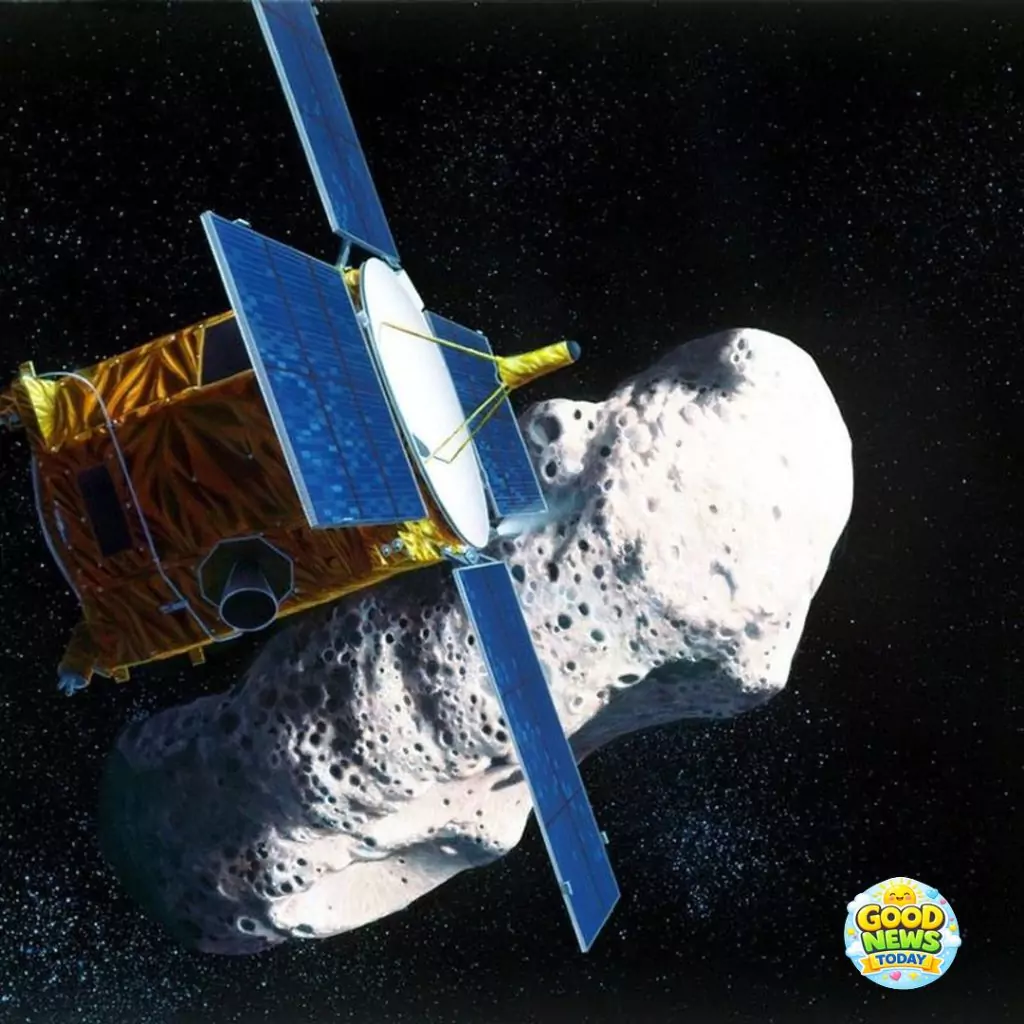
Today marks a remarkable milestone in space exploration, as we celebrate the 25th anniversary of the NEAR Shoemaker spacecraft’s historic landing on the asteroid Eros 433. This event marked the first time in human history that a spacecraft successfully orbited and touched down on an asteroid. Eros, the second-largest known near-Earth object, was an ideal choice for this mission, allowing NEAR Shoemaker to orbit its 13 by 33-kilometer structure for a full year, from February 2000 to February 2001, before landing on its surface.
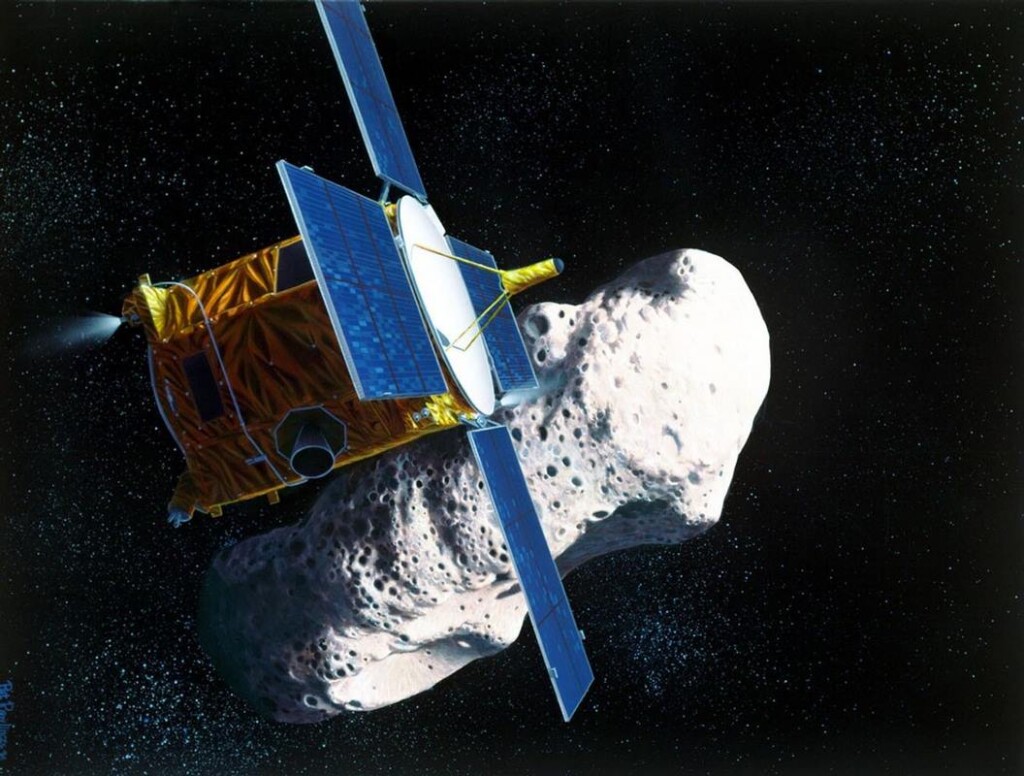
To achieve this incredible feat, the spacecraft had to carefully track Eros’ heliocentric orbit around the Earth, timing its entrance into the asteroid’s weak gravitational field by aligning its trajectory and speed perfectly. Prior to the approach, it was confirmed that Eros had no moons, which meant NEAR Shoemaker could choose the most efficient path for both orbit and landing. During its descent, the spacecraft skillfully reduced its speed from 19.3 meters per second to just 8 meters per second within a narrow window as Eros came close to Earth.
The data collected from this 4.5 billion-year-old asteroid revealed fascinating insights, including its cratered surface and a lower density than previously thought. NEAR Shoemaker’s findings also indicated that Eros lacks a magnetic field. Utilizing a near-infrared spectrometer, the spacecraft managed to map over 70 percent of the asteroid’s surface and gather significant information regarding its interior. Impressively, the mission returned about ten times more data than initially projected, including a staggering 160,000 images.
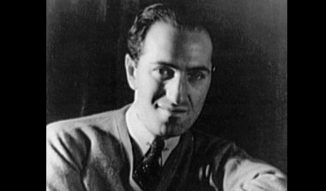
On this day, we also reflect on another significant event in history: 102 years ago, George Gershwin’s iconic Rhapsody in Blue premiered in New York City. This groundbreaking composition, blending classical music with modern jazz influences, was created during a train journey to Boston when Gershwin was just 26 years old. The 9-minute piece soon became one of the most beloved and recognized works in American concert music.
Gershwin described his inspiration, stating, “It was on the train, with its steely rhythms, its rattle-ty bang, that is so often so stimulating to a composer… I heard it as a sort of musical kaleidoscope of America, of our vast melting pot…” The concert, titled An Experiment in Modern Music, was commissioned by conductor Paul Whiteman, attracting many influential musicians, including Rachmaninoff, Stravinsky, and Sousa, who witnessed Gershwin perform live.

Despite a broken ventilation system causing some unrest in the audience, the magic of Rhapsody in Blue unfolded with the clarinet glissando that marks its beginning, captivating everyone present. Leonard Bernstein later praised the piece, stating in 1955, “The themes are terrific, inspired, God-given…”

For a glimpse into this enchanting moment in music history, check out a stunning 1945 clip of Rhapsody in Blue, featuring Robert Alda as Gershwin and Paul Whiteman conducting his band. This biopic beautifully captures Gershwin’s rise to fame and the legacy he created.