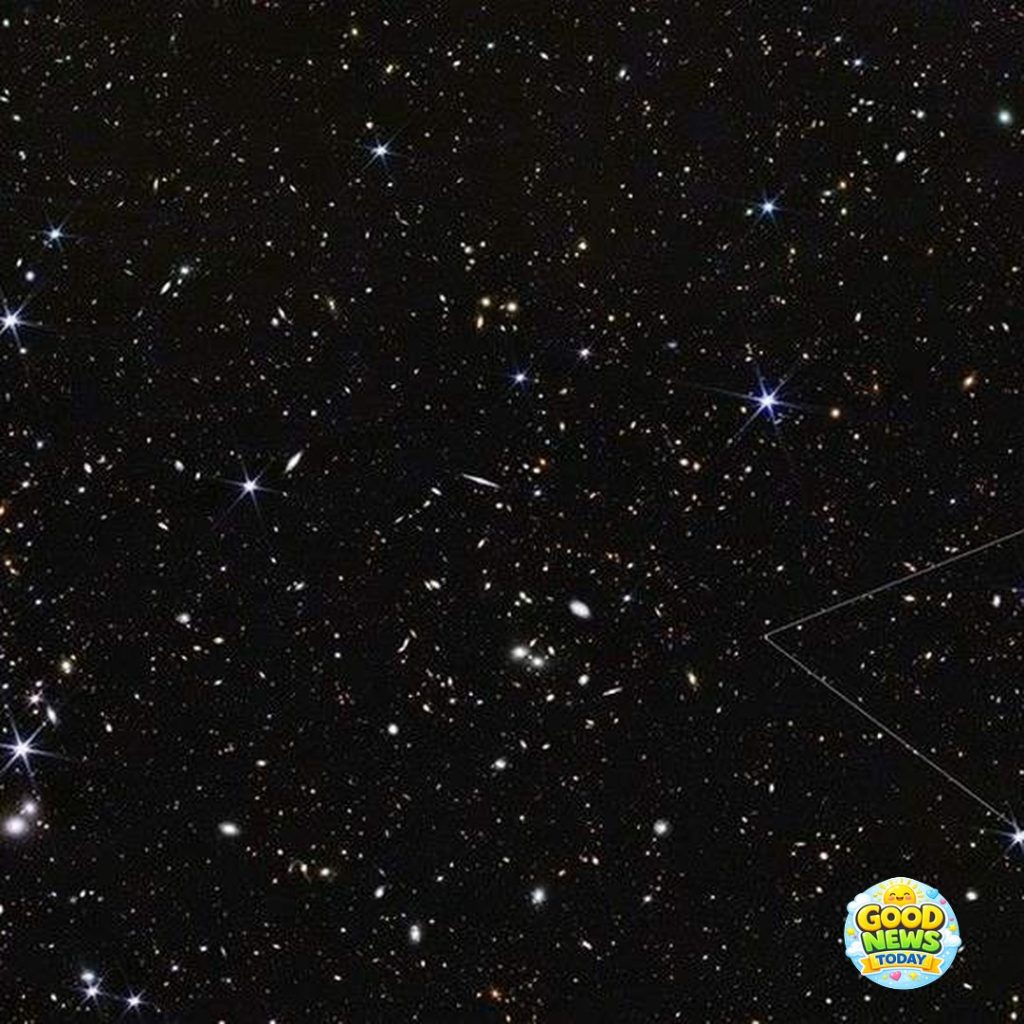
Nasa’s James Webb Space Telescope continues to amaze us, recently confirming the existence of a brilliant galaxy that emerged just 280 million years after the Big Bang. This groundbreaking discovery brings us closer to understanding the universe’s earliest moments than ever before.
Previously, we reported on the observation of a galaxy that existed 300 million years post-Big Bang, and scientists are optimistic that the James Webb will keep shattering these records until we finally witness the universe’s first light.
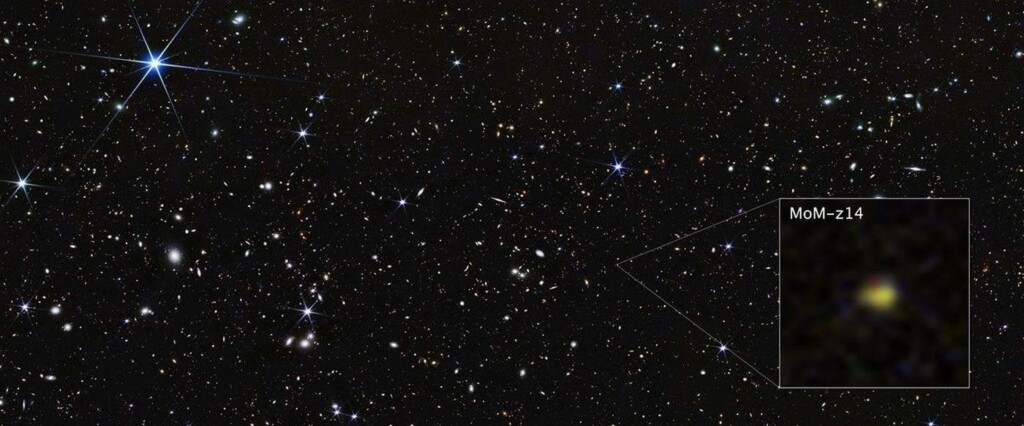
The newly identified galaxy, named MoM-z14, offers fascinating insights into the early universe’s timeline, revealing how vastly different it was from our current expectations.
“With Webb, we can see farther than humanity ever has before, and the sights we are witnessing are unlike our predictions, which is both challenging and exhilarating,” expressed Rohan Naidu from MIT’s Kavli Institute for Astrophysics and Space Research, the lead author of the study on MoM-z14 published in the Open Journal of Astrophysics.
As the universe expands due to dark energy, interpreting physical distances and timelines can become complex. Utilizing Webb’s NIRSpec (Near-Infrared Spectrograph) instrument, astronomers confirmed that MoM-z14 has a cosmological redshift of 14.44. This means its light has been traveling through expanding space, evolving to longer, redder wavelengths for approximately 13.5 billion of the universe’s estimated 13.8 billion years.
“While we can estimate distances of galaxies from images, it’s essential to follow up with detailed spectroscopy to accurately understand what we are observing and when,” commented Pascal Oesch from the University of Geneva, co-principal investigator of the survey.
MoM-z14 is part of a surprising trend of exceptionally bright galaxies appearing in the early universe—about 100 times more than theoretical predictions suggested before Webb’s launch, according to the research team.
“There is an increasing gap between theoretical predictions and observational data regarding the early universe, which opens up intriguing questions for future exploration,” noted Jacob Shen, a postdoctoral researcher at MIT involved in the research.
To find answers, researchers are turning their attention to the oldest stars in our Milky Way galaxy. Some of these ancient stars display high levels of nitrogen, a characteristic also observed in Webb’s findings of early galaxies, including MoM-z14.
“We can draw parallels from archaeology by examining these ancient stars in our own galaxy as fossils from the early universe. Fortunately, with Webb’s capabilities, we can also gather direct information about galaxies from that era. It appears we are uncovering similar features, such as the remarkable nitrogen enrichment,” Naidu explained.
With MoM-z14 existing just 280 million years after the Big Bang, there hasn’t been sufficient time for multiple generations of stars to create such high levels of nitrogen in the manner that we initially assumed. This discovery not only enriches our understanding of the universe’s history but also inspires further exploration into its many mysteries.