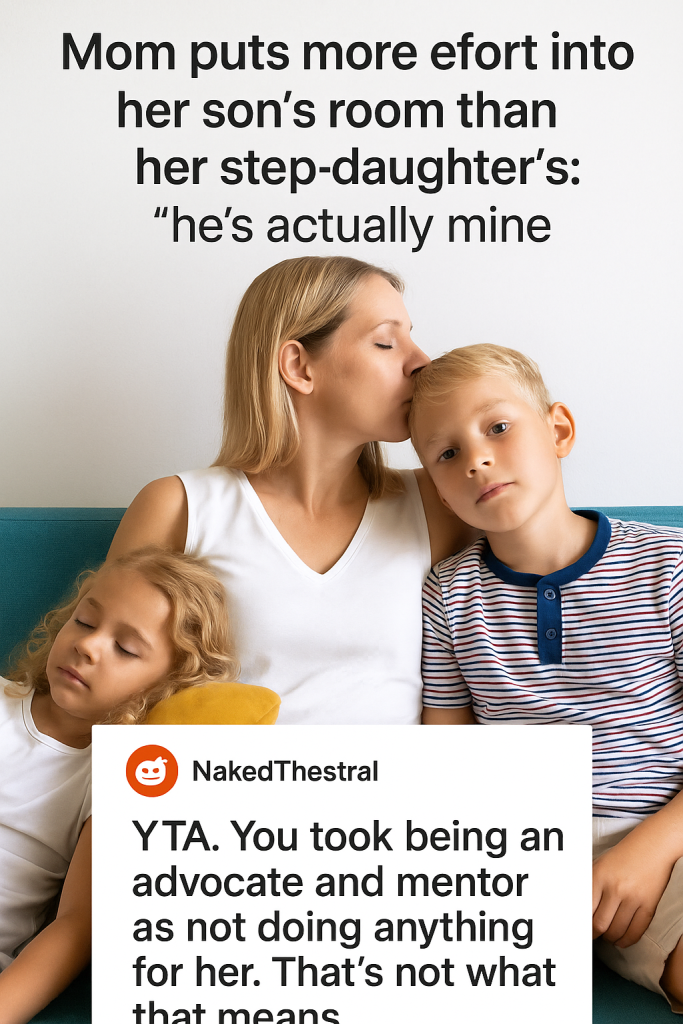
A recent social media post revealing a mother’s stark favoritism towards her biological son over her step-daughter has ignited a fierce debate online about step-parenting, fairness, and family dynamics. The controversy began when a user posted an image sharing the mother’s candid admission: she invests significantly more effort and care into decorating her son’s room, bluntly justifying it with the line, “He’s actually mine.”
The post, which has since gone viral, features the mother’s comment alongside photos highlighting the evident disparity in the conditions of the children’s rooms. The son’s room is lavishly decorated, well-organized, and personalized, while the step-daughter’s space appears noticeably neglected and less personalized. This visual contrast paired with the mother’s unapologetic justification has stirred discussion about equity in blended families.
Many commentators have criticized the mother’s attitude as insensitive and unfair. The phrase “he’s actually mine” has been described online as dismissive of the step-daughter’s place in the family and a sign of emotional favoritism that could harm family bonds. Critics argue that step-parents have a responsibility to nurture and support all their children equally, regardless of biological connections.
Supporters of the mother, however, have defended her stance, suggesting that prioritizing her biological child’s needs and preferences is natural and understandable. Some argue that step-parenting is complex and that affection and investment often develop over time. Yet, the overwhelming online sentiment points toward the need for greater inclusivity and attentiveness to every child’s emotional wellbeing in blended family environments.
Experts in family psychology weigh in, emphasizing that children thrive best when treated with equal care and respect in mixed households. Emotional neglect of a step-child, even if unintended, can lead to feelings of rejection and long-term psychological effects. Psychologists advise clear communication, empathy, and active efforts to create balanced family dynamics to avoid such pitfalls.
The controversy was amplified by the mother’s username, NakedThestral, who had posted commentary suggesting that advocating strongly for her biological son justified the disparity in attention. Online users frequently tagged her as “YTA” (You’re The Asshole) in discussions, a popular judgment indicating social disapproval of her position.
This incident has sparked a broader conversation about the challenges faced by blended families and the importance of equitable parenting. While biological ties can shape emotions and priorities, most agree that the emotional health and security of every child in the household must be a primary concern. As the story continues to trend, it has inspired many families to reflect on their own approaches to fairness and inclusivity at home.
Ultimately, the debate highlights the delicate balancing act in step-parenting roles: honoring natural bonds without alienating stepchildren, and creating a supportive environment where all children feel valued and loved equally.