
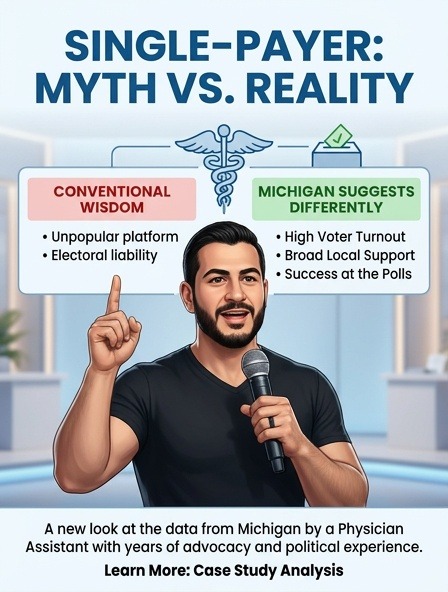
For years, healthcare advocates and political strategists have warned against running on the promise of *Medicare for All* or single-payer healthcare during elections. The prevailing wisdom has been clear: such bold promises are polarizing and potentially damaging in competitive races, especially in states where healthcare remains a hot-button issue. However, recent developments in Michigan suggest that this conventional wisdom may need a second look.
As a practicing physician assistant and long-time advocate for universal healthcare, I’ve heard the same advice echoed repeatedly: avoid pushing for *Medicare for All* on the campaign trail, fearing it could alienate moderate voters or rural constituents. Yet, Michigan—a state with a diverse electorate and significant health disparities—offers a compelling case that bold healthcare reforms can resonate with voters and even shift political dynamics.
During the recent Michigan elections, candidates who prioritized healthcare reform and explicitly endorsed *Medicare for All* saw unexpectedly strong support. Not only did these candidates outperform expectations, but they also energized grassroots organizers and mobilized working-class voters who often feel left behind by the current system. This suggests that the issue of healthcare policy is more complex than the traditional campaign wisdom assumes.
One of the key factors driving this shift appears to be the public’s frustration with the existing healthcare system, characterized by high costs, inaccessible coverage, and ongoing disparities. As voters grapple with these concerns—particularly in rural and underserved statewide communities—they are increasingly open to bold, comprehensive solutions. The Michigan example demonstrates that framing healthcare as a human right, rather than a partisan issue, can foster bipartisan support and drive electoral success.
Healthcare advocates, including myself, argue that the time has come to challenge entrenched political narratives. While skepticism about single-payer legislation is understandable given its controversial history, Michigan’s recent electoral tactics prove that it can work when presented as an equitable solution to systemic problems. The success also brings into focus the importance of grassroots organizing and clear messaging that emphasizes healthcare access as a moral imperative, not just a policy idea.
As the nation continues to grapple with rising healthcare costs and disparities, Michigan’s experience is a powerful reminder: electoral campaigns can and should ask voters to imagine a better system—one that guarantees coverage for all. The traditional advice to avoid running on Medicare for All warrants reevaluation, especially as evolving voter attitudes shift in favor of comprehensive, equitable healthcare reform.
Further research and real-world examples make it clear that bold issues like single-payer healthcare, once considered too risky, could become pivotal in shaping the future landscape of American politics. Michigan’s recent results urge political candidates and advocates alike to reconsider the potential of this transformative policy.