
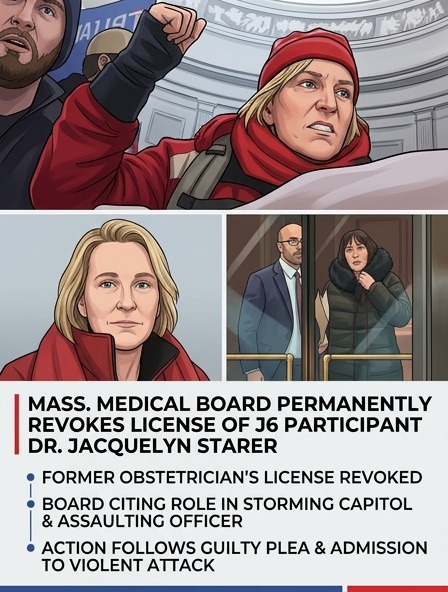
In a decisive move highlighting that accountability extends beyond presidential pardons, the Massachusetts Board of Registration in Medicine has taken the unprecedented step of permanently revoking the medical license of Dr. Jacquelyn Starer, a longtime obstetrician-gynecologist from Ashland. The board’s Final Decision and Order, issued on July 16, come after her role in the January 6, 2021, Capitol riot and her violent encounter with law enforcement.
Starer, known in her community for her expertise in obstetrics and addiction medicine, made headlines when her past actions resurfaced amid the broader discussions about accountability and justice for those involved in the Capitol insurrection. On that day, she stormed the Capitol building, where she was recorded striking a Metropolitan Police officer with her closed fist. She also directed obscene language at officers, actions that serve as a stark contrast to her professional image as a healthcare provider dedicated to patient care and community service.
The federal legal consequences mirrored her behavior at the Capitol. Starer pleaded guilty to eight federal counts, including two felonies, and was subsequently sentenced to nine months in federal prison. Despite her criminal conviction, then-President Donald Trump issued a pardon early in his second term, wiping away the legal accountability for her actions at the Capitol. That pardon, controversial and widely debated, effectively erased her criminal record but did not impact her professional licensing status.
It was a different story in Massachusetts, where her medical license was scrutinized independently. The state’s Board of Registration in Medicine ultimately decided that her violent actions and participation in the Capitol riot were incompatible with the responsibilities entrusted to a healthcare professional. The board’s decision permanently revokes her license, preventing her from practicing medicine in Massachusetts ever again.
Adding weight to the case, the police officer who was assaulted in the Capitol corridor spoke out during the sentencing phase. The officer testified that she feared for her life during the incident, emphasizing the seriousness of Starer’s conduct and its implications beyond mere criminal charges. Her courageous testimony underscored that while a presidential pardon can wipe away criminal convictions, it cannot undo the damage done to public trust or the consequences imposed by state licensing authorities.
The fallout extends beyond the legal and professional spheres. Starer’s attorneys express a sense of loss, claiming that losing her ability to practice medicine has deeply affected her life. However, critics argue that her actions, which included participation in an insurrection and assaulting law enforcement officers, should have consequences that reflect the gravity of her behavior—especially given her role as a healer entrusted with public safety and trust.
This case serves as a stark reminder that a presidential pardon, while powerful, does not absolve individuals from all accountability. States maintain their own standards and disciplinary measures, and in this instance, Massachusetts sent a clear message: violent insurrectionists and those who assault public servants are not fit for the medical community’s trust.