As the Supreme Court prepares to weigh in on President Donald Trump’s executive order aimed at ending birthright citizenship for children born in the United States to illegal immigrants, a recent Fox News poll shows a significant shift in public opinion on this contentious issue.
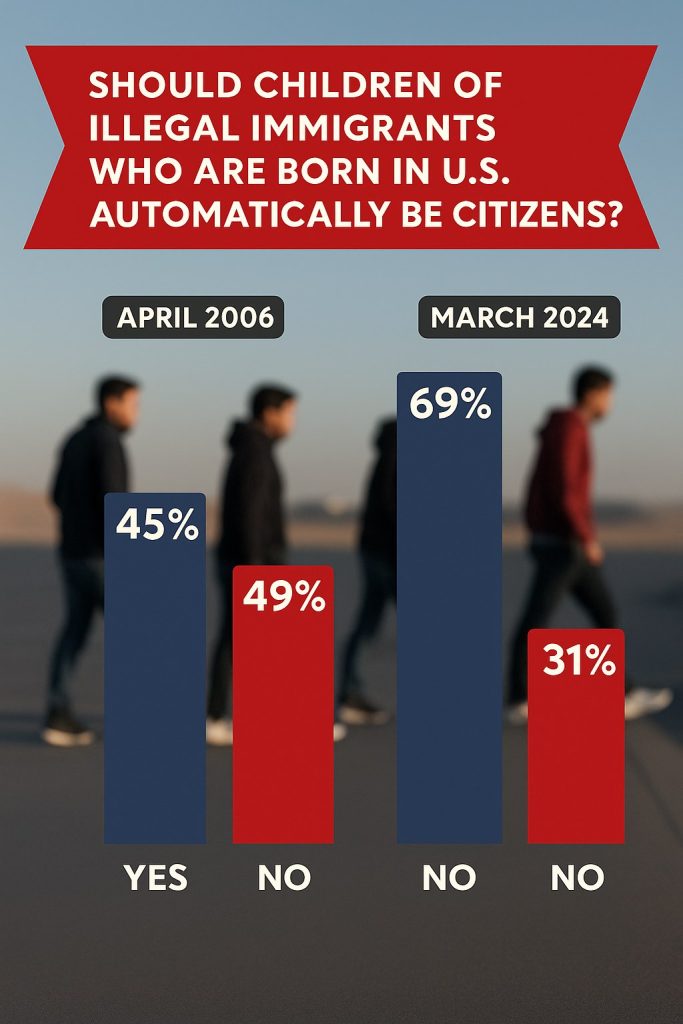
According to the poll, 69% of voters now support granting birthright citizenship to children born on U.S. soil, regardless of their parents’ immigration status. This marks a striking increase from just 45% support recorded in 2006 when Fox News first asked this question. Opposition to birthright citizenship has dropped correspondingly, with only 31% opposed in the latest poll compared to a near-even split two decades ago.
This dramatic change highlights evolving attitudes among Americans. Legal experts and political analysts believe several factors have contributed, including growing awareness of the legal traditions anchored in the 14th Amendment of the Constitution, as well as shifting demographics and a broader understanding of immigrant issues in the U.S.
The 14th Amendment, ratified in 1868, states that “all persons born or naturalized in the United States, and subject to the jurisdiction thereof, are citizens of the United States and of the state wherein they reside.” This has long been interpreted to guarantee birthright citizenship.
President Trump’s executive order challenged this interpretation by declaring an end to automatic citizenship for children born to non-citizen parents unlawfully present in the country. The order, however, did not have the force of law and sparked intense debate over its constitutionality.
As the Supreme Court prepares to address this issue, the recent polling data suggests the public remains steadfastly in favor of the traditional understanding of birthright citizenship. This contrasts with the policy direction favored by then-President Trump and some conservative lawmakers who argue that the current system encourages illegal immigration and should be reformed.
Experts point out that while the executive order itself is unlikely to withstand legal scrutiny, the case provides an important platform for the Supreme Court to reaffirm or reinterpret the principles of citizenship. The outcome could have far-reaching implications for immigration enforcement, civil rights, and the legal status of millions of people born in the U.S.
Public support fluctuates significantly across demographic groups, with higher support among younger voters and minority communities. The poll also reveals that even among voters who identify as conservative or Republican, a majority favors birthright citizenship, underscoring the broad consensus on this constitutional provision.
As the nation awaits the Court’s ruling, the continued rise in public support for birthright citizenship may influence lawmakers and policymakers deliberating potential immigration reforms. The issue remains a key flashpoint in ongoing U.S. immigration debates, reflecting deep societal values about belonging, equality, and the rule of law.
For many Americans, the principle that citizenship is a birthright for all born on American soil remains a foundational tenet of the national identity.
Where to Learn More
- Poll: Majority of voters support birthright citizenship for children born to illegal immigrants – Fox News
- Supreme Court Opinions and Cases – Supreme Court of the United States
- Birthright Citizenship and the Law – Brookings Institution
- Birthright Citizenship: What It Means and Why It Matters – American Immigration Council
- Poll: Rising Support for Birthright Citizenship—What It Means for Election Politics – CNN