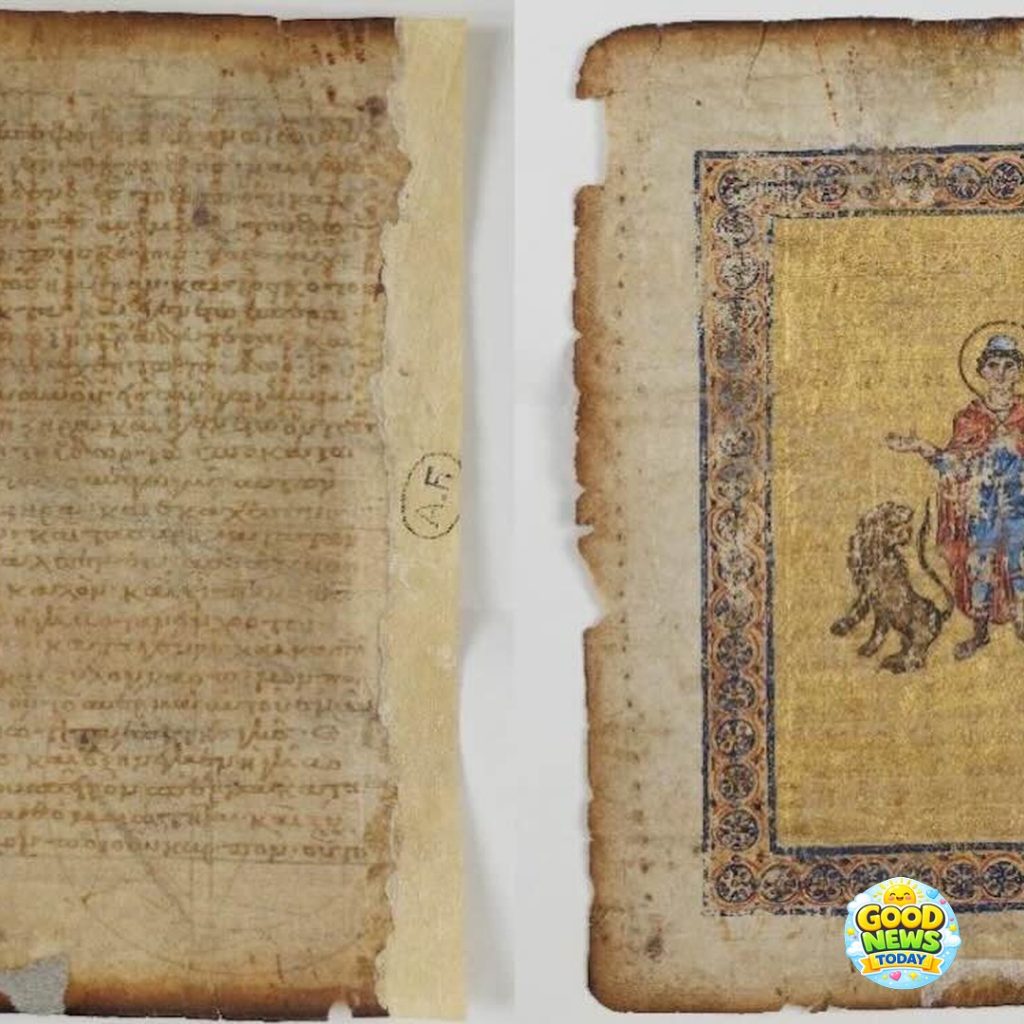
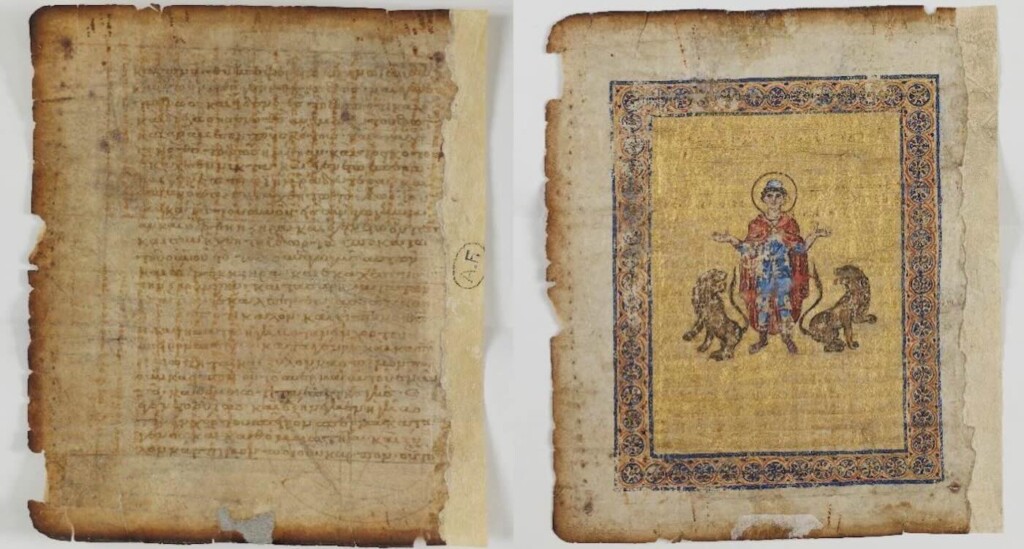
A remarkable discovery has been made at the Musée des Beaux-Arts in Blois, where a page from the famed Archimedes Palimpsest, thought to be lost for many years, has been identified by a dedicated French researcher.
This precious leaf features a segment from the treatise “On the Sphere and the Cylinder,” specifically Book I, Propositions 39 to 41, much of which is still clearly visible on the ancient parchment, which dates back over 1,500 years.
Victor Gysembergh, a researcher affiliated with the National Center for Scientific Research (CNRS), recognized this page within the museum’s collection. It was previously known from photographs taken in 1910, now housed at the Royal Danish Library.
One side of the page is partially obscured by Greek prayers that overlay geometric diagrams, while the other side has a twentieth-century illustration depicting the Prophet Daniel in the company of two lions. Beneath this modern artwork lies the ancient text, currently inaccessible through standard examination techniques.
With the necessary permissions, Gysembergh and his team at the CNRS’ Léon Robin Center for Research on Ancient Thought are planning to conduct pioneering X-ray imaging studies within the next year. This exciting research aims to reveal the hidden text beneath the illustration.
The story behind this remarkable find is as fascinating as the manuscript itself. The parchment is believed to have been crafted by the illustrious Isidore of Miletus, who designed the original structure that would become the Hagia Sophia in Istanbul. This codex includes works by the renowned Greek mathematician Archimedes and other significant figures.
Originally copied onto parchment in 950 CE, the manuscript was taken to a Greek Orthodox monastery in Palestine before the Crusaders sacked Constantinople in 1204. It remained there for 900 years, during which it was washed and repurposed for Greek religious texts—a process known as palimpsesting. In 1899, it was still held by the Greek church and was photographed by Johan Heiburg in Istanbul.
In 1922, the manuscript vanished during the evacuation of the Greek Orthodox library in the city, a chaotic time following World War I, eventually making its way into a private French collection.
The CNRS noted that the Ministry of Culture later sanctioned its export and sale to Christie’s Auction House in New York City in 1998, a move that faced opposition from the Greek church. A US court ruled in favor of the auction, and the manuscript was ultimately acquired by an anonymous buyer, referred to as “Mr. B,” who deposited it for conservation and study at the Walters Art Museum in Baltimore. Reports suggest that this mysterious buyer may be Jeff Bezos, the founder and CEO of Amazon.
This exciting discovery of the Archimedes Palimpsest not only highlights the rich history of ancient texts but also ignites curiosity about the knowledge that could still be uncovered beneath its layers.