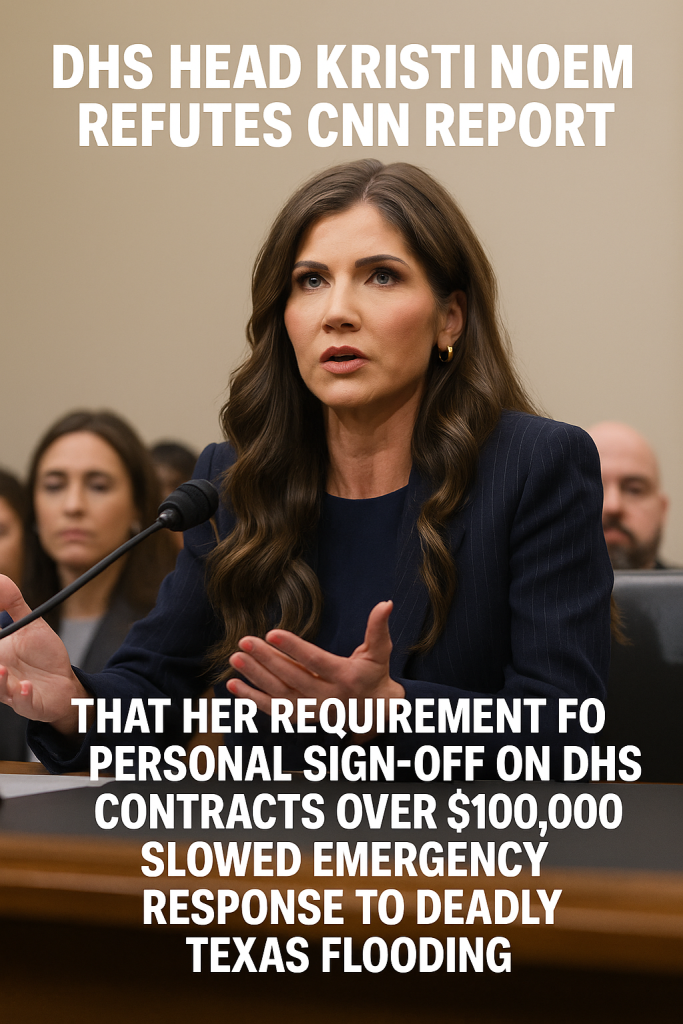
Department of Homeland Security (DHS) head Kristi Noem has publicly refuted allegations that her requirement for personal sign-off on contracts exceeding $100,000 hindered emergency response efforts during the recent deadly flooding in Texas. As the state grappled with one of its worst flood disasters in recent years, criticism emerged claiming that bureaucratic red tape slowed critical aid. Noem, however, firmly dismissed these claims, asserting that her oversight accelerated and streamlined the response rather than obstructing it.
The controversy began after reports surfaced suggesting that DHS contracts related to flood relief were delayed due to Noem’s policy requiring her direct approval for expenditures above a $100,000 threshold. Critics argued this protocol introduced unnecessary delays at a time when rapid deployment of resources was vital to save lives and provide assistance to affected communities.
In a detailed statement addressing the concerns, Noem explained that the personal sign-off policy was implemented to enhance accountability and ensure funds were judiciously allocated during emergency situations. She emphasized that the system was designed to be both thorough and efficient, integrating real-time communication with field teams to prevent any slowdowns.
“Emergency response demands both speed and accountability. My oversight guarantees we maintain financial discipline without sacrificing responsiveness,” Noem said. “Contrary to the claims, our teams mobilized swiftly, and the contracts were executed without undue delay.”
Federal and state officials involved in the relief operations have offered mixed views. Some acknowledge the heightened scrutiny on contracts may have introduced additional administrative steps but maintain that these measures were essential for transparency given the scale of funding involved. Meanwhile, several local responders praised the DHS efforts for quickly deploying resources such as temporary shelters, rescue personnel, and critical supplies.
The Texas floods, which caused significant loss of life and property damage, prompted widespread demand for an effective and coordinated federal response. Early reports indicated challenges with communication and logistics, sparking debates over the efficiency of government agencies in disaster situations. Noem’s contract approval requirement became a focal point amid these discussions.
Experts in emergency management note that while bureaucratic processes can sometimes slow operations, personal oversight requirements like those instituted by Noem are not uncommon in large agencies managing significant budgets during crises. They argue such protocols aim to mitigate risks of misuse or misallocation of funds, particularly when millions of dollars are involved.
Looking ahead, DHS officials plan to conduct a thorough review of the response protocols used during the Texas flooding, including contract approval processes, to identify any barriers and opportunities for improvement. Noem reiterated her commitment to adapt policies in ways that optimize both efficiency and accountability.
In the intense environment following natural disasters, balancing rapid action with responsible fund management remains a complex but critical challenge. Kristi Noem’s recent defense underscores the ongoing debate about how best to achieve that balance in federal emergency responses.