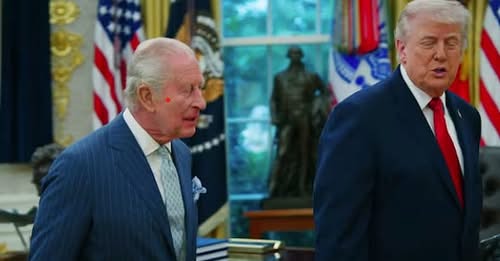
In an unexpected reveal that has quickly gone viral across social media, reports emerged of a candid moment between King Charles III and former President Donald Trump that has since captured public intrigue and sparked widespread speculation. According to sources, during a recent visit, King Charles reportedly viewed the transformed Oval Office and remarked, “It was something.” While this seemingly innocuous comment was shared by Trump during an interview, many have interpreted it as a subtle critique rather than a compliment.
What makes this exchange particularly notable is Trump’s subsequent amplification of the moment. During a media interview, he repeated King Charles’s comment as if it were a positive endorsement, saying, “King Charles saw what I did to the Oval Office, and he said, ‘It was something.'” Many observers took this as an attempt by Trump to present himself in a favorable light, perhaps to suggest royal approval or admiration. However, the reality may carry a different tone.
The context of the remark is key. King Charles’s words, “It was something,” can be interpreted as an understatement—perhaps a polite way of acknowledging a highly controversial or unconventional redesign. The Oval Office has historically been a symbol of American power and tradition, and Trump’s renovations—ranging from bold decor choices to personalized memorabilia—have divided opinions. Some see his redesigns as a mark of individual flair, while others perceive them as disrespectful to the office’s dignity.
Immediately following the revelation, social media erupted with debate. Critics argued that Trump’s portrayal of the interaction as a compliment was disingenuous or an overreach, while supporters dismissed concerns, insisting Trump’s style was bold and authentic. Meanwhile, many are scrutinizing whether King Charles’s comment was intended as a diplomatic compliment or veiled criticism, adding a new layer of intrigue to the royal’s perceptions of American politics.
Political analysts suggest that this incident exemplifies how subtle remarks can be spun to serve different narratives, especially in today’s polarized climate. It also raises questions about the dynamics between global figures and their perceptions of American leadership styles.
Regardless of interpretation, the story demonstrates how a brief, seemingly mundane comment can quickly become a viral sensation—highlighting the power of social media in framing political and cultural discourse. As the debate continues, many await further clarifications or insights from those who witnessed the exchange firsthand.