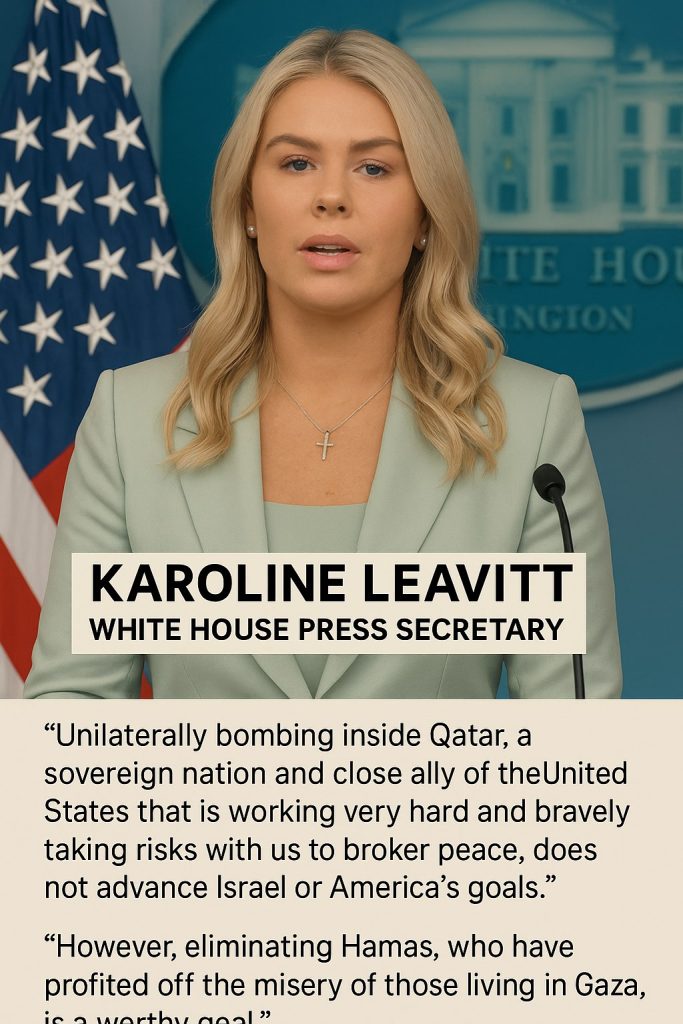
In a sharply worded statement issued this week, Karoline Leavitt, a prominent U.S. political commentator and former White House communications official, criticized Israel’s recent airstrike targeting Hamas leadership reportedly located in Qatar. The strike, which has sent shockwaves through diplomatic circles, has raised concerns about the delicate regional dynamics and the broader implications for peace efforts in the Middle East.
Leavitt emphasized that “unilaterally bombing inside Qatar, a sovereign nation and close ally of the United States that is working very hard and bravely taking risks with us to broker peace, does not advance Israel or America’s goals.” This statement underscored apprehensions regarding the operational and diplomatic fallout from conducting military actions on the territory of a key U.S. partner and mediator.
The Israeli airstrike reportedly targeted senior commanders of Hamas believed to be operating within Qatar’s borders, a move that marks a significant escalation given Qatar’s role as a diplomatic intermediary. Qatar has long maintained a unique position in the region, acting as a crucial conduit between Hamas and various international stakeholders, including the United States.
Leavitt balanced her criticism by acknowledging the strategic objective behind the strike: “Eliminating Hamas, who have profited off the misery of those living in Gaza, is a worthy goal.” Her remarks appear to differentiate between opposing the means and location of the strike while recognizing the broader desire to neutralize Hamas’s influence.
Since Hamas’s rise as a dominant force in Gaza, various governments, including Israel and the United States, have sought ways to dismantle or weaken its leadership. However, the approach has often been fraught with complexity given Hamas’s deep entrenchment in Gaza and its connections to regional actors like Qatar.
The tension following the strike is palpable, as Qatar condemned what it described as a breach of its sovereignty, calling for restraint and dialogue. The airstrike has put Qatar in a difficult position, potentially jeopardizing its ongoing peace mediation initiatives in Gaza and between Israel and Palestinian factions.
International diplomatic sources now suggest that the incident could complicate efforts to broker a lasting ceasefire or peace agreement in the volatile region. The unilateral action by Israel has raised questions among allied nations about coordination and respect for sovereign borders, with some officials worrying that it may fuel further instability.
Leavitt’s nuanced comments reflect a broader conversation within U.S. political circles about balancing robust support for Israel’s security needs with maintaining stable alliances and fostering meaningful peace negotiations. Her highlighting of Qatar’s role signals awareness of the delicate geopolitical chessboard on which the Middle East conflict is played.
As events unfold, the international community will be watching closely to see how Qatar responds diplomatically and whether any retaliatory measures emerge. Meanwhile, Israel maintains that its actions are necessary to degrade Hamas’s operational capabilities, with security officials stressing the importance of disrupting hostile networks wherever they may operate.
Karoline Leavitt’s critique calls for a more strategic, collaborative approach rather than unilateral military strikes that risk alienating key partners and potentially undermining shared objectives. In a conflict as protracted and multifaceted as the Israeli-Palestinian one, such statements highlight the ongoing challenge of pursuing security while navigating complex alliances.
The recent strike and response thus serve as a potent reminder of the interconnected nature of Middle Eastern diplomacy—a landscape where actions against militant groups intersect with the interests and sovereignty of neighboring states and global powers alike.