
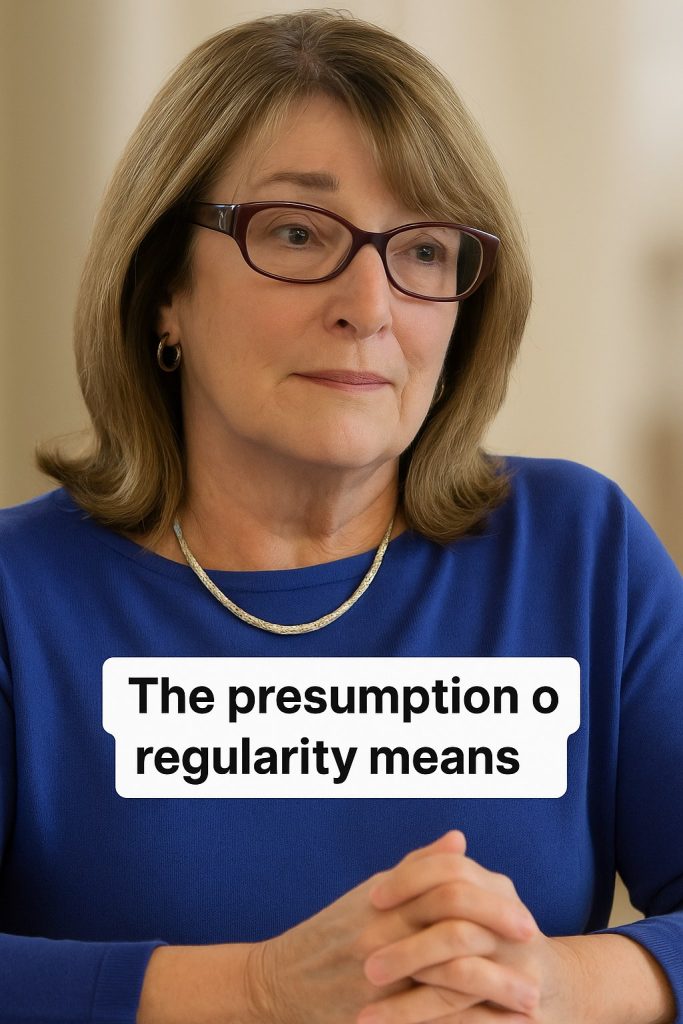
In a provocative discourse that’s resonating widely on social media, Hon. Nancy Gertner, a former U.S. District Judge, has spotlighted a growing concern among judges regarding the Department of Justice (DOJ). Her assertion that the government no longer deserves the “presumption of regularity”—a fundamental legal principle that typically grants governmental actions the benefit of the doubt—has sparked fervent discussions about the integrity of federal actions in recent years.
The concept of presumption of regularity holds that the courts will assume government officials act in good faith unless evidence suggests otherwise. This principle has long been a bedrock of legal proceedings. However, Gertner argues that numerous high-profile and seemingly irregular actions by the DOJ are forcing judges to reconsider this presumption. As politicization appears to seep into the highest echelons of federal law enforcement, some legal minds suggest that the veil of trust between the judiciary and the executive branch is fraying.
In a piece published by the Center for American Progress, CAP’s Devon Ombres elaborated on Gertner’s insights, highlighting specific instances where the DOJ’s motives have come under scrutiny. From perceived biases in high-stakes prosecutions to questionable decisions in handling sensitive investigations, critics argue that the DOJ’s actions have raised red flags that warrant judicial skepticism.
Gertner, who served on the bench from 1994 to 2011, pointed out that judges are no longer willing to accept government motions at face value. “When there are blatant irregularities, courts must act according to the evidence in front of them, not just the standard operating procedures that previously guided them,” she stated. This sentiment echoes throughout the legal community, where pressure mounts for greater transparency and accountability in federal institutions.
The implications of this skepticism could be far-reaching. If the courts begin to systematically shift away from granting the presumption of regularity to the DOJ, it may have significant consequences for ongoing cases and the overall trust in federal law enforcement. Judges might adopt a more critical lens, leading to increased scrutiny of DOJ investigations and prosecutions which were once accepted as routine.
The controversy is not purely academic. It underscores a broader public sentiment regarding the government and accountability, particularly in a climate where political involvement often appears to overshadow legal impartiality. With trust in governmental institutions dwindling, the judiciary may find itself in an unprecedented position where it must rigorously interrogate the motives behind federal actions.
Gertner’s remarks resonate with a populace increasingly wary of the political baggage that seems to envelop the DOJ. As more voices join the conversation, it raises a pressing question for our democratized legal landscape: How can courts uphold justice when governmental actors no longer command the presumption of good faith?
As this bold discussion gains traction in public forums and legal circles, it is clear that the relationship between the judiciary and the executive may need reevaluation, potentially leading to significant transformations in the way justice is administered at all levels.
Where to Learn More
- Does a Politically Directed Department of Justice Merit the Presumption of Regularity? – Center for American Progress
- The Presumption of Regularity and the Role of Public Confidence in the Justice System – Brookings Institution
- What is the Presumption of Regularity and Why Does It Matter? – Lawfare Blog