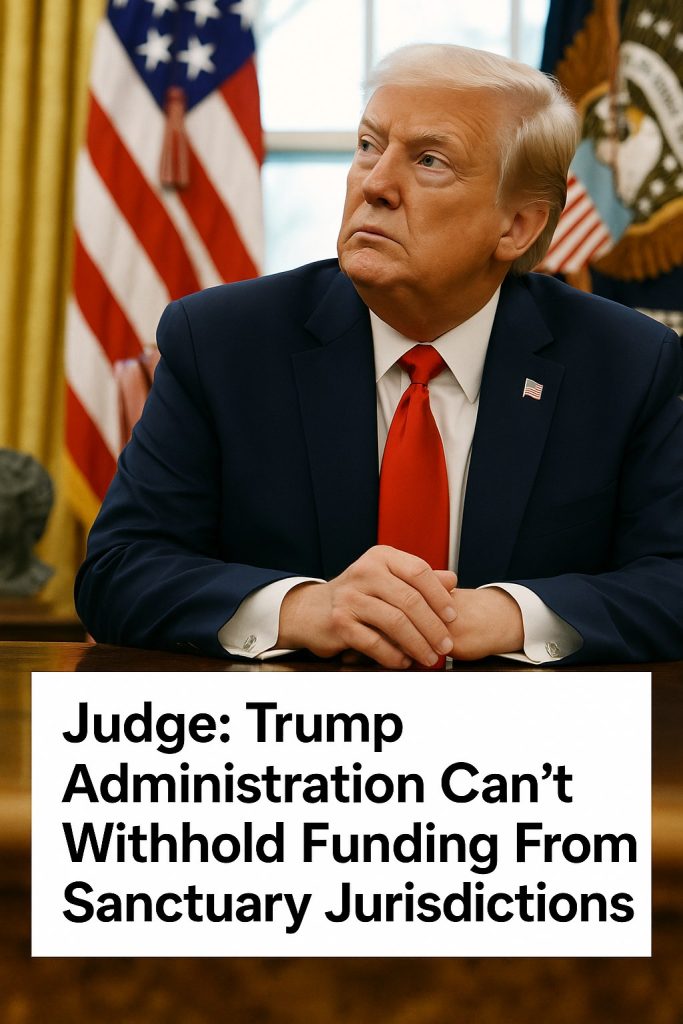
A federal judge has delivered a significant ruling against the Trump administration’s efforts to withhold federal funds from “sanctuary” jurisdictions—cities and states that limit cooperation with federal immigration enforcement. The decision marks a pivotal moment in the ongoing legal battles over immigration policy and federal funding authority.
The court’s ruling prohibits the administration from denying federal financial aid to local governments that have chosen to restrict their law enforcement agencies from cooperating fully with Immigration and Customs Enforcement (ICE). This ruling comes amid heightened tensions between immigration enforcement policies and the autonomy of local governments that serve sizable immigrant communities.
Sanctuary cities and jurisdictions are localities that have adopted policies to avoid using municipal resources for federal immigration enforcement purposes. These policies aim to protect undocumented immigrants from deportation actions, particularly when local police respond to or investigate local crimes. The Trump administration’s policy sought to condition grant money on local compliance with federal immigration efforts, attempting to strengthen enforcement at the local level.
However, critics argued that this conditional funding violates legal norms and infringes on states’ rights and local governance, raising constitutional concerns. The judge’s ruling sided with these arguments, emphasizing that the federal government cannot strip essential funds simply because municipalities decline to participate in immigration enforcement programs.
This ruling further clarifies the limits of executive authority in leveraging federal funds to influence local policy decisions. It underscores that while the federal government has broad powers, it cannot unilaterally compel local jurisdictions to enforce federal immigration laws by threatening to cut off funding accepted for unrelated programs such as community development, law enforcement, or health services.
In recent years, sanctuary jurisdictions have contended with federal pressure and threats of financial penalties, advocating for policies that promote immigrant trust in local authorities without fear of deportation. These efforts are often justified on public safety grounds, as officials argue that immigrant communities are less likely to report crimes if they fear immigration consequences.
The ruling also arrives amid the 2024 presidential election cycle, where immigration remains a top issue. The decision could influence policy debates and political strategies, particularly those focused on the balance between federal immigration enforcement and local autonomy.
Legal experts view this ruling as a potential precedent curbing future attempts by any administration to use funding as leverage to enforce immigration policy at the local level. While appeals may be forthcoming, the decision offers immediate relief to sanctuary jurisdictions worrying about the loss of critical federal assistance.
As immigration policy continues to evolve, this court decision highlights the complex intersections of law, politics, and local governance in a country grappling with how best to manage immigration enforcement without undermining community trust and crucial public services.