
The billionaire entrepreneur Jeff Bezos recently found himself at the center of controversy after claiming that the wealthy are being unfairly vilified. In a social media post, Bezos suggested that the criticism directed at the richest individuals is unwarranted and that they are unfair targets in societal debates about inequality and economic disparity.
However, the statement has sparked widespread outrage and skepticism, particularly given Bezos’s own reputation as one of the wealthiest people on the planet. Critics argue that this assertion overlooks the reality faced by many of his warehouse workers and low-income employees. Evidence suggests that despite staggering personal wealth, a significant portion of Amazon’s warehouse staff rely on government assistance programs to make ends meet.
In fact, recent reports indicate that around one-third of Amazon warehouse workers are beneficiaries of public aid, highlighting concerns about the working conditions and wages paid by giant corporations like Amazon. Many social activists and union advocates call this a stark contradiction: while Bezos accumulates billions, his employees struggle to maintain basic living standards.
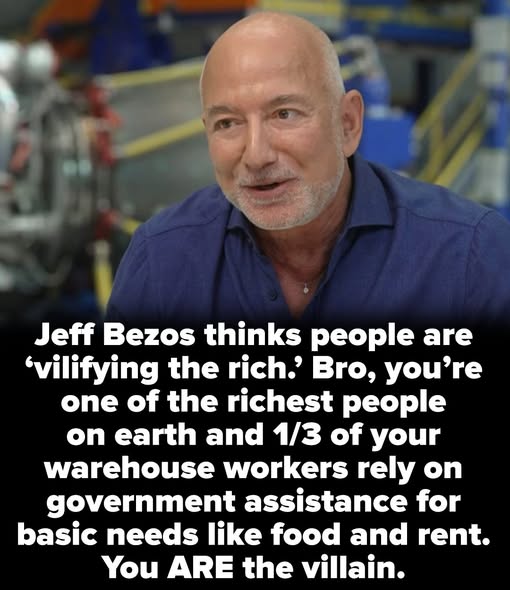
Social media users were quick to voice their reactions, with one viral meme referencing an image of Bezos saying, “People are vilifying the rich.” Overlaid on the image was a pointed critique: “Bro, you’re one of the richest people on earth and 1/3 of your warehouse workers rely on government assistance for survival.”
This controversy underscores the ongoing debate over economic inequality in America. Critics argue that the wealth generated by corporations and individuals like Bezos does not translate into better wages or working conditions for employees. Conversely, some supporters claim that wealthy entrepreneurs contribute significantly to economic growth and job creation, often overlooking issues faced by lower-income workers.
As public scrutiny intensifies, Amazon and its leadership are under increasing pressure to address these disparities. Building on this, advocates are urging for policy reforms such as higher minimum wages and better labor protections, emphasizing that wealth concentration should not come at the expense of worker welfare.
Jeff Bezos’s comments have reignited conversations about the role of the ultra-wealthy in society and whether they are doing enough to contribute to the communities generating their fortunes. The debate continues to unfold on social media, with many questioning if the rhetoric from individuals like Bezos aligns with the realities faced by millions of ordinary workers.
Where to Learn More
- Amazon Workers and the Fight for Fair Wages – The New York Times
- Jeff Bezos Accused of Ignoring Worker Struggles Amid Pandemic Profits – Business Insider
- Wealth Inequality and the Lives of Low-Income Workers – Public Citizen
- The Growing Gap Between Riches and Worker Wages – Forbes