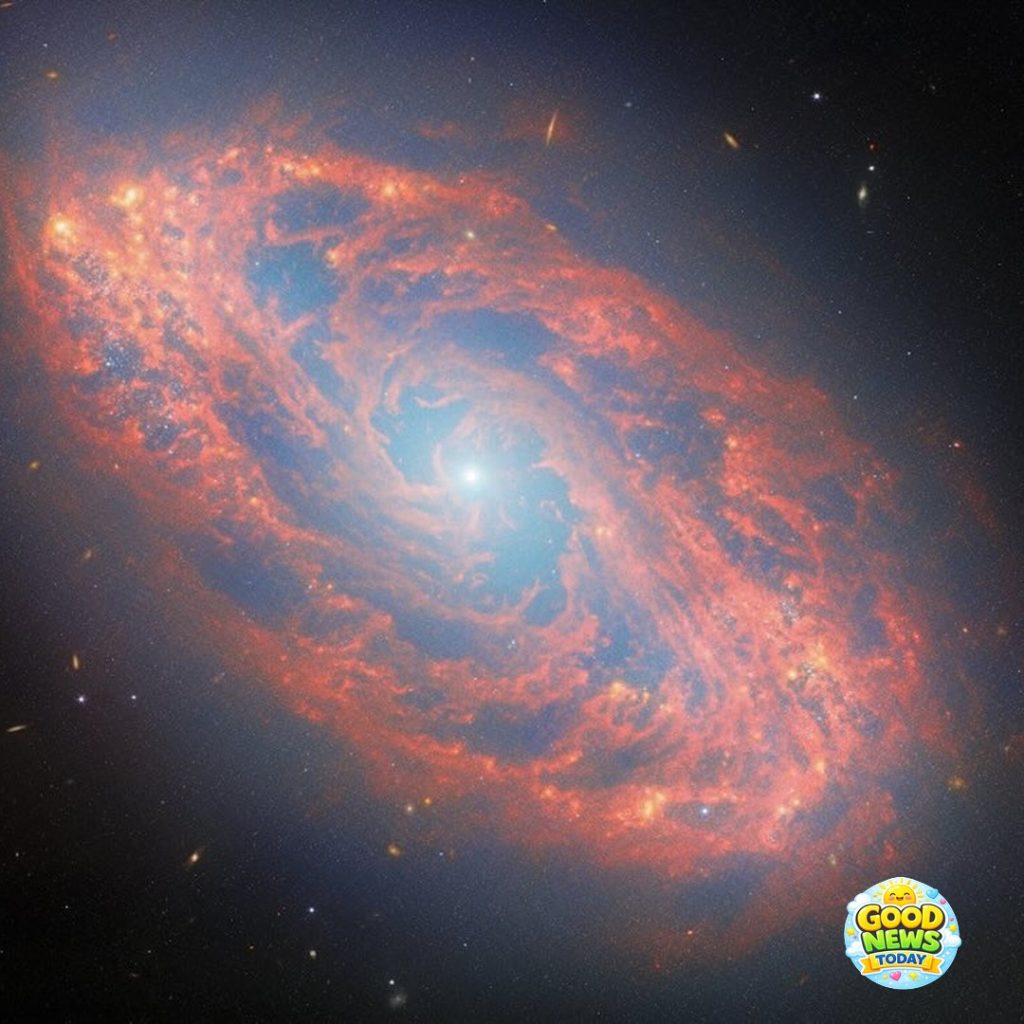
A stunning image captured by the James Webb Space Telescope has revealed a spiral galaxy whose light has been traveling through space since the time the Tyrannosaurus rex roamed the Earth. This spectacular photograph showcases NGC 5134, a galaxy located 65 million light-years away from us.
According to NASA, the European Space Agency, and the Canadian Space Agency, NGC 5134 is relatively nearby in cosmic terms. While 65 million light-years might sound vast, the light collected by the Webb telescope has been on its journey since shortly after the extinction of the T. rex.
The breathtaking image, taken on February 20, provides a glimpse into the distant past. By examining nearby galaxies like NGC 5134, situated in the Virgo constellation, astronomers can enhance their understanding of more remote galaxies that appear as mere pinpricks of light.
The proximity of this star system enabled two of Webb’s advanced instruments to work in tandem, capturing incredible detail in the galaxy’s tightly coiled arms. Webb’s mid-infrared instrument reveals warm dust and complex molecules swirling within the galaxy’s clouds, while its near-infrared camera focuses on the stars and clusters nestled within those clouds.
Discovered in 1785 by the German-British astronomer William Herschel, NGC 5134 may also harbor an “active galactic nucleus,” a compact area at the galaxy’s center that emits substantial energy across the electromagnetic spectrum—indicating that this luminosity is not solely produced by stars.
The image showcases gas clouds that swirl along the galaxy’s spiral arms, serving as sites for star formation. As new stars are born, they consume the galaxy’s supply of star-forming gas, and when these stars eventually die, they recycle some of that gas back into the galaxy.
This intricate balance between gas and stars is central to a collaborative program by NASA, ESA, and CSA, which aims to study 55 galaxies in our nearby universe that are actively forming new stars across a wide range of wavelengths.
NASA highlights that the new data from Webb contributes to a deeper understanding of individual star clusters and star-forming clouds. It has already been used to investigate the life cycle of tiny dust grains, the nature of star-forming clouds, the relationships between interstellar gas and dust, and how newly formed stars shape their environments.
Share this breathtaking new photo with fellow astronomy enthusiasts on social media, and let’s celebrate the wonders of our universe together!