In the ever-evolving landscape of international diplomacy, the role of Jared Kushner—former senior advisor to President Donald Trump and his son-in-law—has come under renewed scrutiny. A viral social media post recently reignited a contentious debate regarding Kushner’s legitimacy and motivations when representing the United States on the global stage.
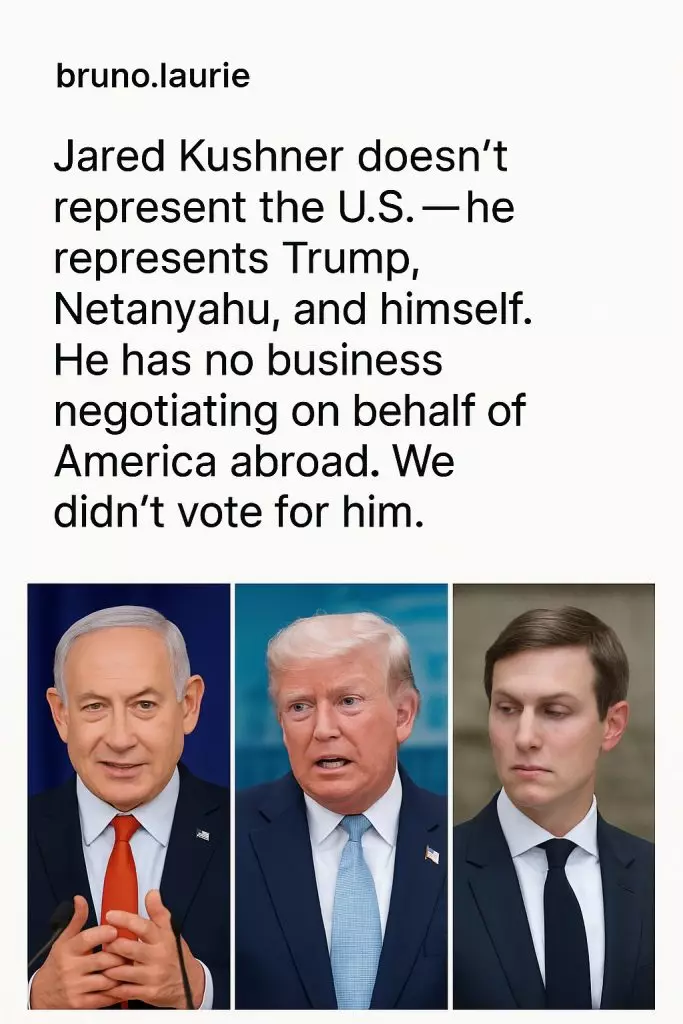
The post bluntly asserts: “Jared Kushner doesn’t represent the U.S.—he represents Trump, Netanyahu, and himself. He has no business negotiating on behalf of America abroad.” This message reflects a growing sentiment among critics who question Kushner’s impartiality and alignment, especially considering his close ties to both Trump and Israeli Prime Minister Benjamin Netanyahu.
Kushner played a pivotal role in several high-profile diplomatic initiatives during the Trump administration, most notably the Abraham Accords. These historic agreements established normalized relations between Israel and several Arab nations, including the United Arab Emirates, Bahrain, Sudan, and Morocco. While praised by many for breaking longstanding barriers in Middle Eastern diplomacy, skeptics have argued that Kushner’s approach is shaped more by personal and political interests than by a broad vision of American foreign policy.
Critics point to Kushner’s perceived conflicts of interest and question his qualifications for such critical diplomatic responsibilities. Unlike career diplomats with decades of experience, Kushner’s background centers largely on real estate and business ventures. Moreover, his close personal relationships with Netanyahu and Trump have led to accusations that his efforts disproportionately advance the agendas of these figures rather than the United States at large.
Supporters counter that Kushner’s unconventional approach was precisely what allowed him to accomplish breakthroughs that eluded traditional diplomacy for decades. They argue that strong personal connections helped facilitate candid talks and foster trust among negotiators from historically adversarial countries.
This debate underscores a larger question about the nature of diplomatic representation in the modern era: Should personal ties and political loyalty influence who is empowered to negotiate on behalf of a nation? And to what extent should officials be challenged when their actions appear to serve narrower interests?
As the United States continues to navigate complex geopolitical relationships, the controversy surrounding Jared Kushner’s diplomatic role remains a divisive topic. The viral social media discourse is reflective of broader dissatisfaction and calls for accountability in how American foreign policy is conducted.
Ultimately, the conversation sparked by this viral post speaks to the democratic imperative that those chosen to represent a country’s interests abroad must do so with integrity, transparency, and a commitment to the nation as a whole—not just to select individuals or factions.
Where to Learn More
- Jared Kushner and Middle East Peace Efforts – CNN
- Was Jared Kushner qualified to be a diplomatic envoy? – BBC News
- Jared Kushner’s Lasting Impact on Middle East Diplomacy – The Atlantic
- Trump’s Son-in-Law: The Diplomat and the Controversy – The New York Times