
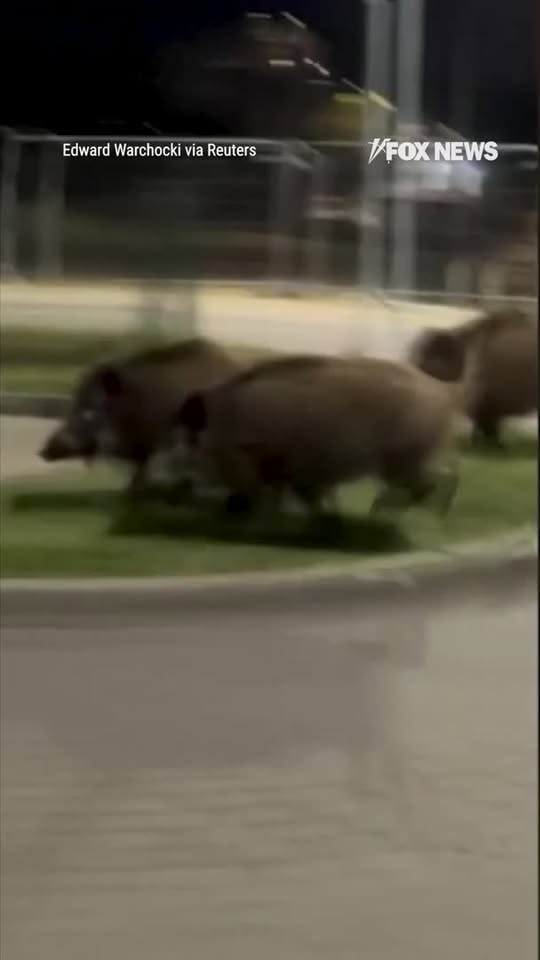
A startling video from Warsaw, Poland, has captured a groundbreaking moment in urban wildlife management: a humanoid robot actively chasing a herd of wild boars out of a residential area. The footage, which has quickly gone viral on social media, showcases cutting-edge robotic technology being deployed to address human-wildlife conflicts in an urban environment.
The video shows a humanoid robot, approximately human-sized, equipped with mobility features and possibly sensors to detect movement and animal presence. As the wild boars navigated into a busy neighborhood, the robot appears to approach them calmly but assertively, guiding or chasing the animals away from populated areas. Witnesses describe the robot maneuvering with precision, creating a fascinating spectacle of technology in action.
This incident marks a notable step in urban wildlife management, especially in cities like Warsaw, where wild boars have increasingly become an issue in recent years. With urban expansion displacing natural habitats, wild boars often wander into neighborhoods, posing safety risks for residents and increasing property damage. Authorities typically rely on traditional methods such as trapping or tranquilizing animals, but these approaches can be time-consuming, stressful for the animals, and sometimes ineffective.
The deployment of a humanoid robot to handle these situations signals an innovative approach to coexistence challenges. Developed by a local tech company specializing in robotics and AI, the robot is designed to be non-lethal and environmentally friendly. Its current role seems to be focused on gentle deterrence—using movement and sound to guide the wild boars away from human dwellings without harm.
Experts see this incident as a potential model for urban wildlife control globally. Dr. Emilia Nowak, a wildlife ecologist at the University of Warsaw, emphasizes the significance: “Using robots to manage urban animal conflicts could revolutionize how cities handle these increasingly common issues. It offers a humane, efficient alternative to traditional methods, and as this technology advances, it could become an integral part of urban planning.”
While some critics are cautious about relying too heavily on robotics in sensitive ecological situations, the current case appears to demonstrate a positive step forward. The city officials have expressed interest in exploring more robotic solutions for various public safety concerns, from traffic management to pest control.
As viral videos like this one continue to spread, they highlight a future where technology and nature intersect in unprecedented ways—raising questions about safety, ethics, and the evolving role of robots in our daily lives. The sight of a humanoid robot actively guiding wild animals away from human spaces not only captures imagination but also signals a new era of urban coexistence.