
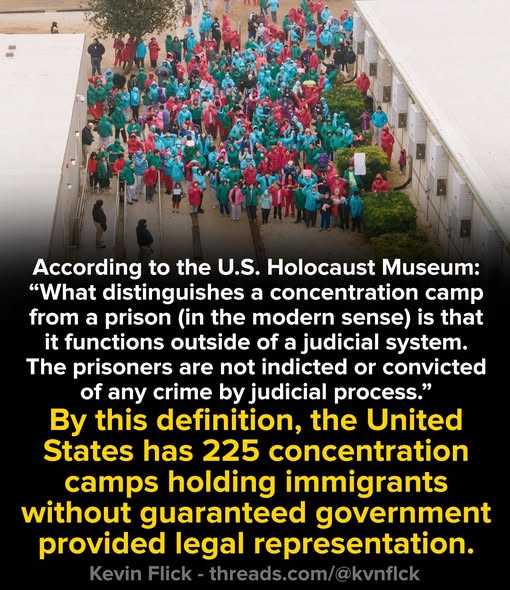
In the wake of ongoing discussions about human rights and historical atrocities, a recent social media post has reignited an important conversation about the nature of concentration camps versus prisons. An image circulating online prominently features a quote from the U.S. Holocaust Museum that reads: “What distinguishes a concentration camp from a prison (in the modern sense) is that it functions outside of a judicial system.”
This statement encapsulates a critical aspect of how we understand some of the darkest chapters in history. Historically, concentration camps — as used during the Holocaust and other genocides — were designed not merely as detention facilities, but as instruments of persecution, extermination, and state terror. Unlike prisons, which operate under the rule of law and judicial oversight, concentration camps function outside or in direct opposition to the legal system, often targeting specific groups based on ethnicity, political beliefs, or religion.
The distinction becomes even more relevant considering recent global events and the rise of authoritarian regimes, where detention centers are sometimes described as “prison-like” but essentially serve as tools for repression without due process. The U.S. Holocaust Museum emphasizes that the defining feature is the absence of judicial oversight and the arbitrary, often brutal, treatment of detainees.
Dr. Stephen Smith, director of education at the museum, explained: “Legal processes are fundamental to our justice system. When a detention facility operates outside these processes — without trials, hearings, or fair procedures — it shifts from being a prison to a concentration camp.” This distinction underscores the importance of legal protections for individuals and the dangers of state mechanisms that sidestep justice.
The social media post serves as a reminder that understanding history is vital for preventing future atrocities. As reported, many regimes have utilized detention centers as means of suppression and extermination, often leading to genocide. The Holocaust epitomizes this, where millions of Jews, Roma, disabled individuals, and others were sent to camps specifically designed to annihilate them, with no judicial process involved.
Experts stress the importance of recognizing the nuances in detention facilities worldwide. While “prison” generally implies a legal process with safeguards, “concentration camps” — regardless of location or name — are characterized by their extrajudicial, terror-inducing nature. This understanding is crucial for fostering accountability and protecting human rights.
Educators and human rights advocates continue to stress the importance of historical literacy, warning that mischaracterizing such facilities can lead to dangerous complacency or normalization of abuses. Recognizing these differences helps societies confront patterns of repression and work towards safeguarding justice and dignity for all individuals.