
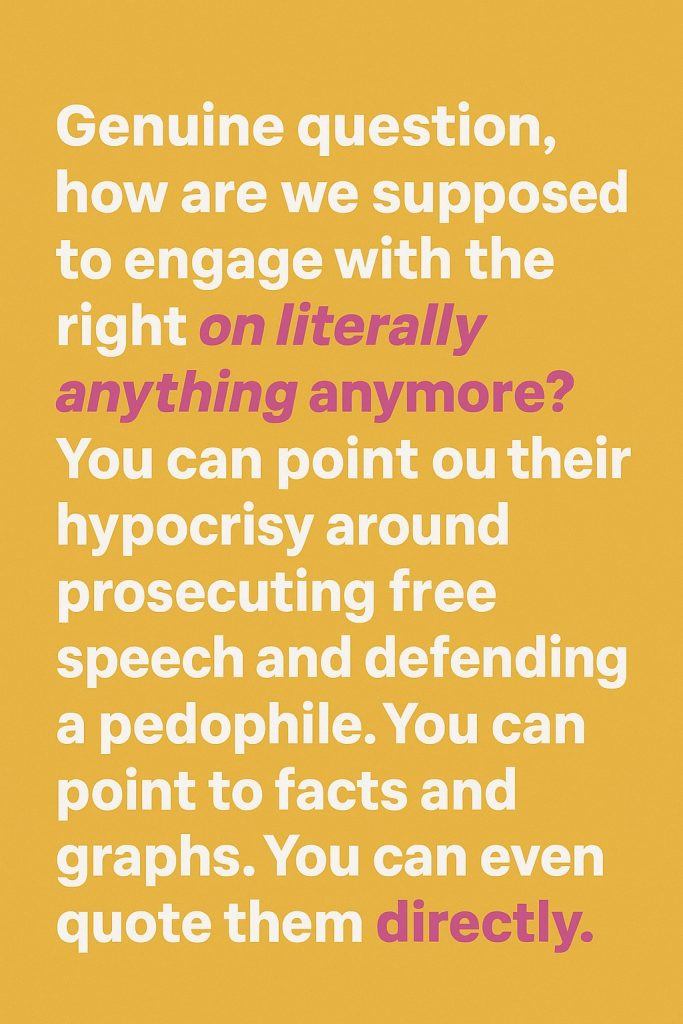
In a climate increasingly characterized by political polarization, social media users are finding themselves at a crossroads when it comes to engaging with opposing ideologies. A recent post by user @vicwingly has gone viral, posing a poignant question that resonates with many: “Genuine question, how are we supposed to engage with the right on literally anything anymore?” This thought-provoking inquiry sheds light on the escalating frustration many feel when attempting to engage in constructive dialogue with conservative viewpoints, particularly in light of perceived hypocrisies.
The contemporary political environment has seen a rise in social media as a battleground for ideologies, where users often highlight contradictions in the stances held by those on the political right. As @vicwingly suggests, issues surrounding the prosecution of free speech have become particularly polarizing. The question arises: how can one effectively participate in discussions when opposing parties appear to uphold double standards?
Many social media users have flagged this hypocrisy, pointing out how some right-wing figures decry censorship while simultaneously advocating for policies that target dissenting voices. This paradox creates a challenging landscape for productive discourse. Instead of engagement, social media often devolves into echo chambers where only like-minded opinions are validated and opposing voices are drowned out.
Experts suggest that this environment may dissuade individuals from bridging the ideological divide. “When people feel that their values are constantly under attack, it’s easier to retreat into groups that affirm those beliefs,” says Dr. Amanda Connors, a political psychologist at the University of California. “This can lead to a cycle where constructive dialogue is entirely abandoned.” Dr. Connors emphasizes the importance of seeking common ground, stating, “Starting a conversation on shared values rather than differences can lay the groundwork for more meaningful exchanges.”
However, many feel that reaching out is an uphill battle, especially as tensions rise on platforms like Twitter and Facebook. Critics argue that more often than not, attempts at engagement are met with hostility, leaving many people feeling discouraged. This dynamic adds layers of complexity to the original question posed by @vicwingly: how can one engage meaningfully with the right when the stakes seem so high?
Notably, some have taken to these platforms to offer advice on better communication strategies. Recommendations include employing empathetic listening—a technique that urges individuals to fully understand the perspective of those they are engaging with—before presenting counterarguments. Others advocate for emphasizing shared values and concerns, which can serve to unite rather than divide.
This shift in approach could also empower individuals to articulate their viewpoints more effectively, creating windows for productive conversations rather than futile debates. Until users begin to adopt such strategies, the question posed by @vicwingly continues to linger in the digital ether. The evolution of political dialogue on social media remains uncertain, but the potential for transformation is promising if only individuals are willing to step outside of their comfort zones.
Where to Learn More
- How Political Polarization Affects Social Media Engagement – NPR
- The Challenges of Political Engagement on Social Media – The Atlantic
- The Art of Engaging Others in Political Conversations – Psychology Today
- The Divide: Right vs. Left on Social Media – BBC News