
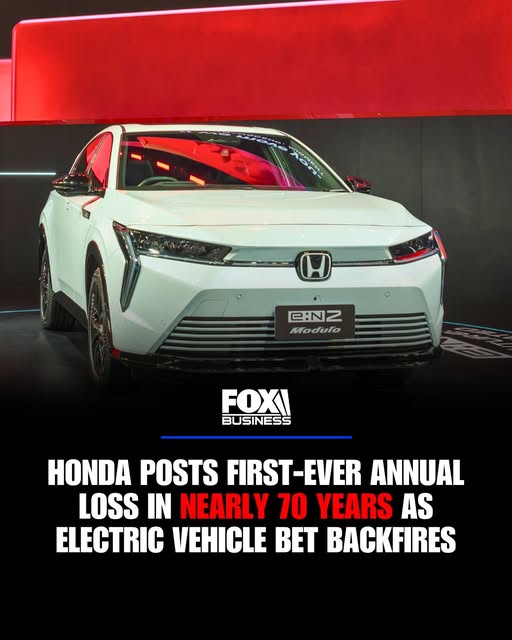
In a surprising turn of events, Honda, one of Japan’s oldest and most revered automakers, reported its first annual financial loss in nearly 70 years. The company’s $2.7 billion deficit marks a stark departure from its tradition of consistent profitability, with its recent struggles largely attributed to its ambitious electric vehicle (EV) push.
Honda’s gamble on expanding its electric vehicle portfolio has been a central pillar of its future strategy. However, recent market and regulatory shifts have significantly impacted this plan. The company announced that it incurred approximately $9 billion in restructuring costs as a result of decreased demand for EVs, coupled with external pressures stemming from U.S. policy changes and consumer preferences.
In a statement, Honda pointed to the rollback of environmental regulations in the United States as a key factor contributing to the decline in EV demand. The company explained that **“EV demand has declined considerably, due to the rollback of environmental regulations in the U.S. and other factors,”** indicating that policy uncertainty and reduced incentives have dampened consumer enthusiasm for electric cars.
Adding to Honda’s woes, President Donald Trump’s administration efforts to bolster domestic manufacturing through “Made in America” policies created additional hurdles for foreign automakers. The emphasis on local production and tariffs has made it more challenging and costly for Honda to expand its EV operations within the U.S., a key market for global automakers.
Honda’s CEO, Toshihiro Mibe, addressed the disappointing financial results during a recent press conference. He revealed that the company would be abandoning its earlier target to make electric vehicles account for 20% of Honda’s profits by 2030. This pivot signifies a broader reassessment of Honda’s electrification strategy amid mounting financial pressure.
“Given the recent market dynamics and regulatory environment, we are reevaluating our targets and investing more prudently,” Mibe said. The company also announced plans to accelerate investments in hybrid and fuel cell technologies, which remain more appealing to certain markets due to infrastructure and consumer preferences.
This development raises questions about the future of Honda’s EV ambitions and signals a potential recalibration in the global electric vehicle race. As the industry teeters on the brink of widespread adoption, traditional automakers like Honda are finding that shifting regulatory landscapes and market demand can complicate strategic plans that once seemed straightforward.
Analysts suggest that Honda’s experience might serve as a cautionary tale for other automakers heavily invested in EV transition, especially as policies and consumer preferences continue to evolve. The company’s foray into electric vehicles, once seen as a decisive step towards sustainability, now appears to be a complex balancing act involving market realities and geopolitical considerations.
Where to Learn More
- Honda Reports First Loss in Nearly 70 Years Amid EV Challenges – Reuters
- Honda Cuts EV Growth Targets Amid Market Uncertainty – BBC News
- Honda’s Electric Strategy Faces Hurdles as Profits Drop – The Wall Street Journal
- Honda Revises EV Goals Amid Slow Sales – Automotive News