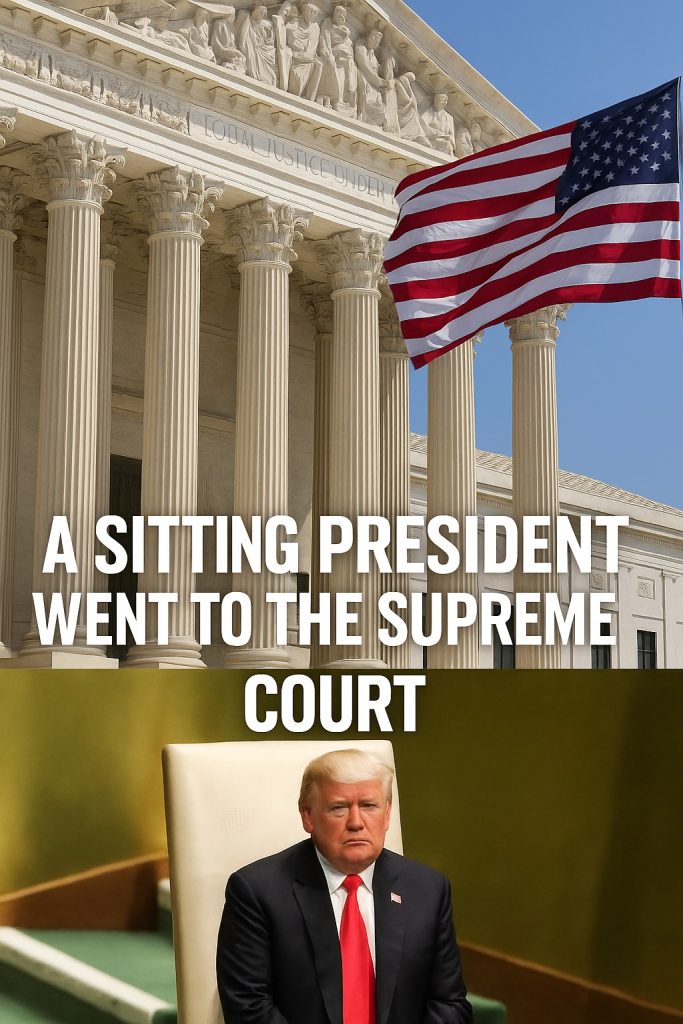
In an unprecedented moment that reverberated through the corridors of American democracy, a sitting president took the extraordinary step of attending a Supreme Court oral argument on a case directly challenging his executive order on birthright citizenship. This marks the first time in nearly 250 years that a president has appeared inside the courtroom during oral arguments — a tradition long respected to maintain the separation of powers.
Yesterday, the eyes of the nation turned to the Supreme Court, where President Donald Trump was present to defend an executive order that aimed to strip children born on U.S. soil to undocumented parents of their automatic citizenship, a constitutional right enshrined in the 14th Amendment since 1868. The surrounding tension was palpable not only because of the legal stakes, but because of the extraordinary context in which the president faced the justices — including three conservative members he personally appointed: Justices Neil Gorsuch, Brett Kavanaugh, and Amy Coney Barrett.
On the eve of the hearing, President Trump publicly denounced these very justices as “disloyal” for indicating skepticism of his position, an unprecedented direct attack on the independence of the Court’s members. His presence in the courtroom the next day was widely interpreted by legal experts and historians as an effort to exert overt pressure on the judiciary. Historian Ruth Ben-Ghiat described it bluntly as “an intimidation tactic to remind judges of the costs of defying him.”
During the 90-minute hearing, the justices methodically dismantled the president’s arguments, upholding the long-established interpretation of the 14th Amendment that guarantees citizenship to “all persons born or naturalized in the United States.” Legal analysts noted that, despite the president’s high-profile attendance, his arguments failed to sway the Court’s skepticism.
The implications of overturning the birthright citizenship principle are staggering. Lawyers warn that hundreds of thousands of children could be rendered effectively stateless, losing the protections and rights that come with citizenship. Moreover, the ruling could force tens of millions of Americans to verify their parents’ immigration status merely to confirm their own legal status, complicating everything from education to healthcare access and employment.
The day before this historic showdown, the president further escalated the rhetoric by issuing another executive order requiring the Department of Homeland Security to create a “citizenship list” with the intent of regulating voter eligibility in 2026. Critics argue this move is part of a wider effort that not only questions who belongs in America but also who gets to participate in its democratic processes.
When the hearing concluded, President Trump left the Supreme Court defeated, with the justices’ refusal to flinch standing as a testament to the enduring strength of American constitutional principles. For nearly two and a half centuries, the U.S. judiciary has stood as a coequal branch that resists undue influence from the executive, safeguarding the rights of the people — including the fundamental right to citizenship by birth.
As this case unfolds, the Court’s steadfast dedication to its role will be critical in preserving the constitutional fabric that underpins American identity and democracy itself.
Where to Learn More
- Supreme Court Challenges Trump’s Birthright Citizenship Order – The New York Times
- Trump’s Historic Supreme Court Appearance and What It Means – The Washington Post
- Why the Supreme Court’s Birthright Citizenship Case Is So Critical – CNN
- The Supreme Court’s Role in Upholding Citizenship Rights – Brookings Institution