
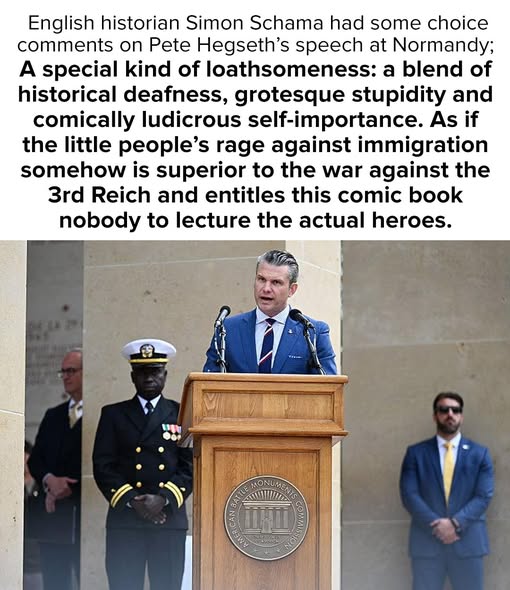
In a recent social media debate that has quickly gone viral, renowned historian Simon Schama delivered a sharply critical assessment of a speech given by Pete Hegseth at Normandy. The exchange has ignited widespread discussion about historical memory, patriotism, and the responsibilities of public figures when addressing moments of national significance.
Hegseth, a prominent political commentator and former military officer, delivered a speech commemorating the D-Day anniversary—a day of immense historical importance marking the Allied invasion of Nazi-occupied France during World War II. While many viewers found his remarks heartfelt and inspiring, critics argued that his speech was marred by historical inaccuracies and tone-deaf assertions.
Enter Simon Schama, a distinguished British-born historian renowned for his expertise in European history and his eloquent commentary on national memory. In a social media post that has since been widely circulated, Schama condemned Hegseth’s speech as “a special kind of loathsomeness: a blend of historical deafness and grotesque insensitivity.”
Schama’s critique pointed to what he perceives as a fundamental misunderstanding or deliberate misrepresentation of the events at Normandy, as well as a failure to honor the complexity and sacrifice embedded in that pivotal moment. “There is a stark difference,” Schama wrote, “between patriotic remembrance and the grotesque oversimplification of history, which diminishes both the past and the sacrifices made.” His remarks resonated with many historians and veterans’ groups, who echoed concerns about the importance of historical accuracy and respect during commemorative speeches.
The controversy highlights a broader debate about how history is presented to the public—particularly by political commentators and public figures seeking to inspire or entertain. Critics argue that Hegseth’s speech, which emphasized certain narratives over others, risks trivializing the nuanced and tragic realities of wartime history. Conversely, supporters claim that Hegseth aimed to celebrate heroism and patriotism.
Schama’s critique also pointed to a troubling pattern among some speakers who, in the name of patriotism, neglect the lessons of history or distort facts to fit modern political agendas. “A true appreciation of history requires humility and acknowledgment of complexity,” Schama emphasized. “Anything less risks turning remembrance into propaganda.”
The exchange has sparked a larger conversation about the role of historians and public intellectuals in shaping collective memory. As commemorations of wartime sacrifices continue, experts stress the importance of honoring history with honesty, respect, and scholarly integrity.
Where to Learn More
- The Guardian: The pitfalls of political speeches at historical memorials
- The Washington Post: Historians criticize patriotic speeches for historical inaccuracies
- BBC News: The significance of accurate historical commemoration at Normandy
- Simon Schama’s official website for his writings on history
- Veterans History Project: Honoring sacrifice and memory