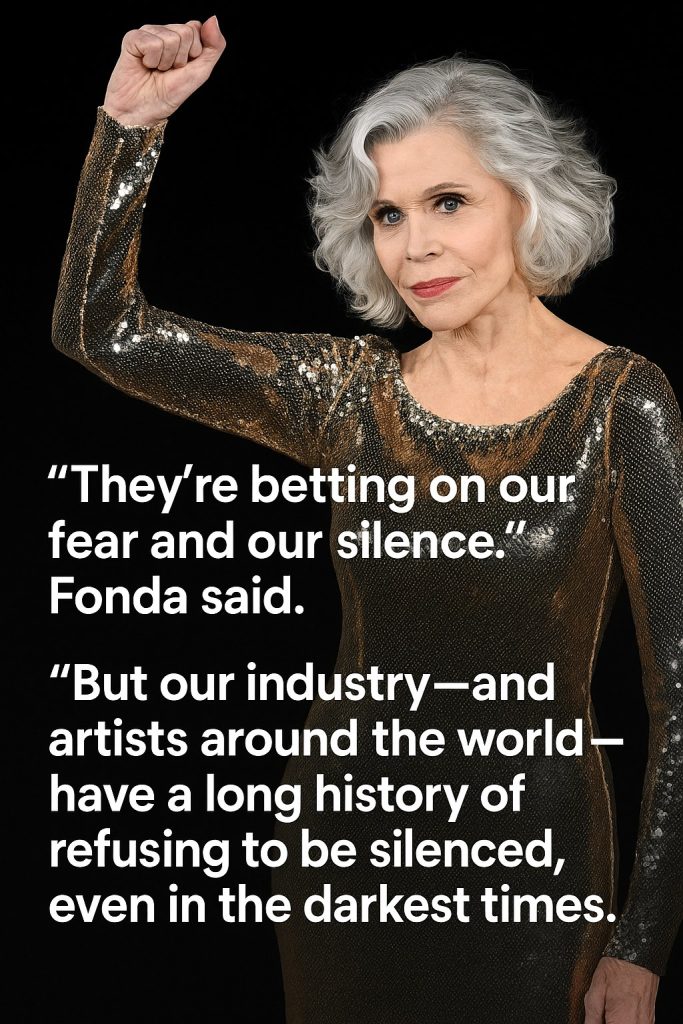
In a powerful statement that has resonated across social media platforms, acclaimed actress and activist Jane Fonda asserted, “They’re betting on our fear and our silence. But our industry—and artists around the world—have a long history of refusing to be silenced, even in the darkest times.” This message, emphasizing the role of artists in social change, comes at a pivotal moment when the artistic community is rallying against mounting censorship and oppression.
Fonda’s remarks were echoed at a recent industry panel focused on the intersection of art and activism, which aimed to unite creators in the face of adversity. Her words serve as a clarion call, inspiring artists to harness their voices to fight against social injustices, inequality, and the pervasive culture of fear that often stifles creative expression.
Throughout history, artists have been at the forefront of social movements, using their craft to challenge the status quo and call for change. From the Harlem Renaissance to the protests against the Vietnam War, the arts serve as a powerful conduit for societal reflection and critique. Fonda’s impassioned plea is a reminder of this legacy and the responsibility that comes with it.
As modern-day censorship attempts to quash dissenting voices, many in the artistic community are stepping up to push back. Numerous artists have utilized platforms like social media to amplify messages that defy oppressive regimes and challenge societal norms, embracing the role of artists as both entertainers and activists.
Furthermore, the current landscape of the film and music industries illustrates the struggles that many creatives face. Recent reports indicate that independent artists, in particular, are becoming increasingly vocal about the challenges they encounter in maintaining their artistic integrity. The emergence of streaming platforms has democratized art but also brought forth new forms of control and censorship that threaten the diversity of expression.
Fonda’s statement highlights not only the power of art in protest but also the solidarity that exists among artists across diverse mediums and backgrounds. Her call to action encourages collaboration across various artistic forms, including visual arts, theater, film, and music, uniting voices in a collective stand against silence and fear.
The conversation surrounding fear and silence is further complicated by the global sociopolitical climate, where freedom of expression is under constant threat. Artists not only carry the mantle of resistance but also face the moral imperative to stand up against injustice. Their ability to connect with audiences on an emotional level makes them effective conduits for change.
As Fonda poignantly stated, the industry has “a long history of refusing to be silenced.” In these times of uncertainty, artists remind us of the past, reinforcing the notion that silencing voices only ignites a stronger resistance. The call to action is clear: artists, creators, and audiences alike must recognize their role in advocating for a world where fear does not dictate our choices and creativity can flourish without constraints.
Where to Learn More
- Jane Fonda: Artists Must Embrace Activism – The Guardian
- The Rich History of Artist Activism – NPR
- Jane Fonda on Censorship and Fear – HuffPost
- How Artists Resist: Jane Fonda’s Call to Action – Vanity Fair
- Arts in Resistance: An Urgent Conversation – BBC News