
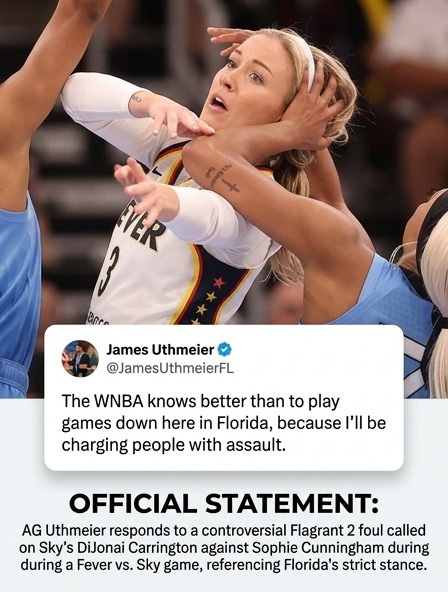
The recent WNBA game between the Indiana Fever and the Chicago Sky has ignited a political firestorm following an intense on-court encounter that has now gone viral on social media. Florida’s Attorney General, James Uthmeier, issued a fiery warning to the league after a controversial foul involving Fever star Sophie Cunningham, raising questions aboutplayer conduct, race, and state-level legal threats.
The incident occurred during a fiercely contested game when Cunningham was called for a flagrant foul that resulted in her being ejected from the game. The foul, which many fans and analysts are describing as “vicious” and “foul,” has become a lightning rod for controversy, sparking outrage from players, fans, and even political figures. The game’s aftermath saw DiJonai Carrington of the Chicago Sky, who was involved in the incident, criticizing Cunningham and the Fever, accusing them of benefiting from “white privilege.”
In a dramatic social media post, Florida AG James Uthmeier responded to the incident with a stern warning that echoes the state’s law enforcement stance. “The WNBA knows better than to play games down here in Florida, because I’ll be charging people with assault,” Uthmeier declared publicly on Twitter. The statement has quickly gone viral, sparking both support and outrage across political and athletic spheres.
Uthmeier’s comments follow a wider national debate about sportsmanship, accountability, and the influence of racial and social dynamics within professional sports. The Florida AG’s aggressive tone appears to be a deliberate message about accountability, with some interpreting his words as a warning against misconduct both on and off the court. Critics argue that his statement heightens tensions and politicizes a sporting incident that many believe should remain within the athletic arena.
Meanwhile, the incident has prompted speculation about possible legal repercussions. While AG Uthmeier’s comments are largely rhetorical, suggesting that violations of Florida law could be pursued if any assault charges are deemed appropriate, legal experts are quick to point out that criminal charges over a sporting foul are unprecedented and unlikely. Nevertheless, the spectacle underscores how high-profile sports conflicts are increasingly intersecting with political rhetoric.
The controversy also raises broader issues about fairness, privilege, and race — central themes that have exploded into the cultural conversation after Carrington’s comments. Critics are debating whether the incident was truly a product of misconduct or if it has been amplified by perceptions of racial bias. The social media outpouring continues to grow as fans dissect every detail of the incident, fueling divides and debate across the nation.
As the story develops, attention remains focused on whether Florida authorities will follow through with legal actions or if this is a case of political posturing. Meanwhile, players and fans alike are reminded of the contentious intersection of sports and politics, where every foul, comment, and social media post can escalate into a national controversy.