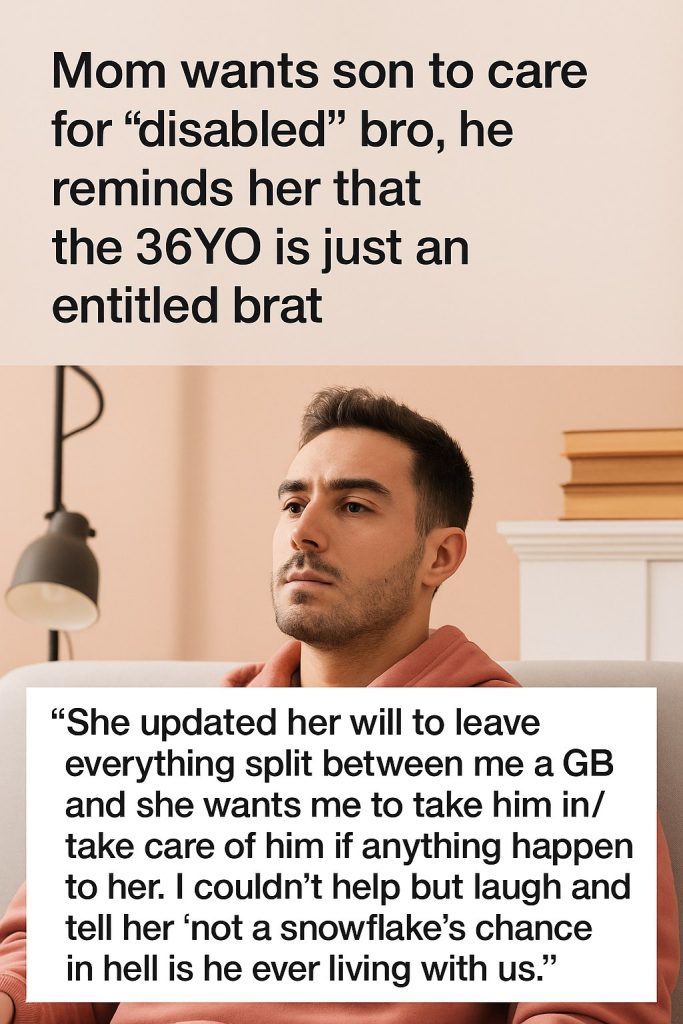
In a poignant tale that has captivated social media users, a mother’s request for her son to care for his older brother, who she describes as “disabled,” has ignited a fierce debate online. The younger sibling argues that the 36-year-old brother is merely an entitled brat, not a victim of severe disability, leading to discussions on familial obligations and the limits of care. This controversial family dynamic, shared widely across platforms, raises questions about the definitions of disability, responsibility, and entitlement in families.
The story began after a shocking revelation from the younger son, who took to social media to express his frustration. His mother, who reportedly updated her will to ensure that everything would be split evenly between her children’s inheritances, expects her younger son to shoulder the care responsibilities for his older brother. “It’s not like he can’t take care of himself. He just chooses not to,” the younger son stated, emphasizing that his brother’s issues stem more from a failure to grow up rather than any legitimate disability.
This sentiment resonates with many who have chimed in on the discussion, with comments ranging from supportive to sharply critical. Some have argued that the mother’s sense of duty is misaligned and that the older brother has been allowed to remain dependent due to parental coddling. “He was never pushed to grow up or take responsibility. It’s about time he faces the consequences of his actions,” one commenter shared, echoing the sentiments of those who believe that a familial obligation does not equate to lifelong servitude.
Others have voiced concern over the mother’s apparent inability to acknowledge the older child’s entitlement. As the conversation unfolded, it brought into focus how familial expectations can often create toxic dynamics. Instead of instilling independence, the older son was raised in an environment where his lack of initiative was tolerated, leading to problematic behaviors that spill over into adult life.
The younger sibling’s frustration raises crucial questions about the balance of care in families. While many parents feel the need to advocate for their children, at what point does this turn into enabling? The social media buzz is not just about one family but resonates with a broader discussion about accountability, especially in adult children who refuse to mature due to lack of incentives.
This debate has sparked an outpouring of shared experiences from individuals who have lived through similar situations, showcasing how common such dynamics can be in families. A Twitter user noted, “It’s hard to balance being a caretaker and an individual. We shouldn’t have to sacrifice our lives for someone who won’t help themselves.”
As the dialogue continues, many are called to reevaluate the definitions of disability and responsibility in family settings. Ultimately, the story has gained traction because it touches upon universal themes of familial obligation, autonomy, and the pressures of modern-day parenting. Follow-ups on the family situation are eagerly awaited, as many hope to see a resolution that embodies growth and accountability, rather than perpetual entanglement in dysfunction.
Where to Learn More
- Understanding Disability and its Implications – National Center for Biotechnology Information
- Entitlement: What It Is and How It Works – Psychology Today
- The Tug-of-War Between Children and Parents – Forbes