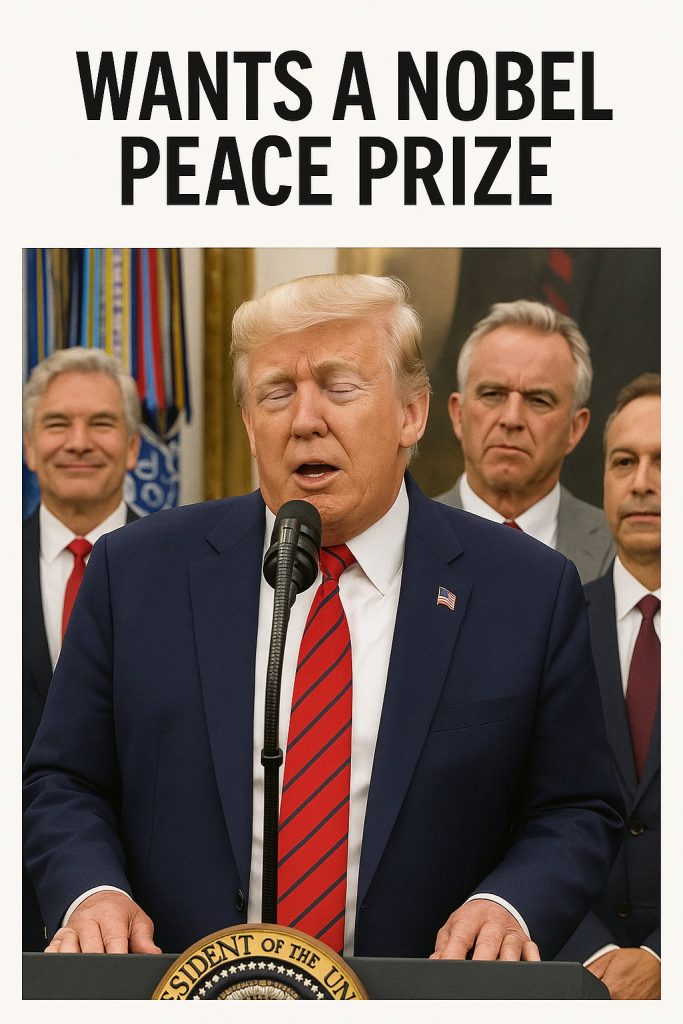
Donald Trump has long expressed a desire for the prestigious Nobel Peace Prize, often touting his administration’s foreign policy achievements as worthy of such recognition. However, critics argue that his real-world actions frequently contradict the fundamental principles upheld by the Nobel Committee. As public discourse heats up on social media, many are questioning whether Trump’s record truly aligns with the criteria that have historically defined winners of this esteemed award.
The Nobel Peace Prize is awarded to individuals or organizations that have made significant strides in promoting peace, resolving conflicts, and advancing humanitarian goals. Recipients like Martin Luther King Jr., Mahatma Gandhi (though never awarded), and Barack Obama have been recognized for their dedication to diplomacy, reconciliation, and peaceful coexistence. Donald Trump’s approach, however, appears far more contentious.
Despite bold rhetoric about peace deals and diplomacy, Trump’s actions have often been divisive. While his administration did broker the Abraham Accords, normalizing relations between Israel, the UAE, Bahrain, Sudan, and Morocco—a move many hailed as a breakthrough—these achievements were overshadowed by a series of polarizing policies. His administration’s withdrawal from the Iran nuclear deal raised tensions in the Middle East. Furthermore, his provocative statements and policies towards North Korea oscillated unpredictably between threats and bromances, casting doubt on his diplomatic consistency.
Trump’s domestic agenda also clashes with the spirit of the Nobel Peace Prize. His tenure amplified societal divisions, provoking widespread protests and unrest. Critics note that peace goes beyond international treaties—it requires fostering cohesion and justice within nations as well.
On social media, users have highlighted the stark contrast between Trump’s eagerness for the prize and the Nobel Committee’s stringent criteria. Tweets and posts frequently point out that the prize celebrates lasting peace efforts, not short-term political victories or media-driven spectacle. Some even speculate that Trump’s public yearning for the prize is motivated more by image than impact.
Experts in international relations caution against oversimplifying complex peace processes, but they agree on one thing: the Nobel Peace Prize is not a trophy for political self-promotion. “The prize is reserved for those who demonstrate genuine commitment to advancing global peace and human rights,” notes Dr. Maria Jensen, a peace studies scholar. “This requires humility, consistency, and an inclusive approach—qualities that have been called into question during Trump’s presidency.”
Ultimately, the tension between Trump’s ambitions and the Nobel Peace Prize’s ideals underlines a broader debate about what it truly means to be a peacemaker in today’s volatile world. While the Abraham Accords may represent a highlight, the totality of Trump’s record complicates any straightforward narrative about earning peace honors. Whether or not he will ever be seriously considered by the Nobel Committee remains uncertain, but his quest has certainly ignited a vigorous conversation on social media and beyond.
As the world looks on, the discourse around peace awards highlights the need for leaders whose actions consistently embody the values those prizes represent. For now, Donald Trump’s path to the Nobel Peace Prize appears more contested than ever.
Where to Learn More
- About the Nobel Peace Prize – Nobel Prize Official Website
- What are the Abraham Accords and why do they matter? – BBC News
- Understanding the Iran Nuclear Deal – Council on Foreign Relations
- Donald Trump and the Nobel Peace Prize: Why It’s Complicated – Deutsche Welle
- Public Reaction on Twitter – Twitter Search