
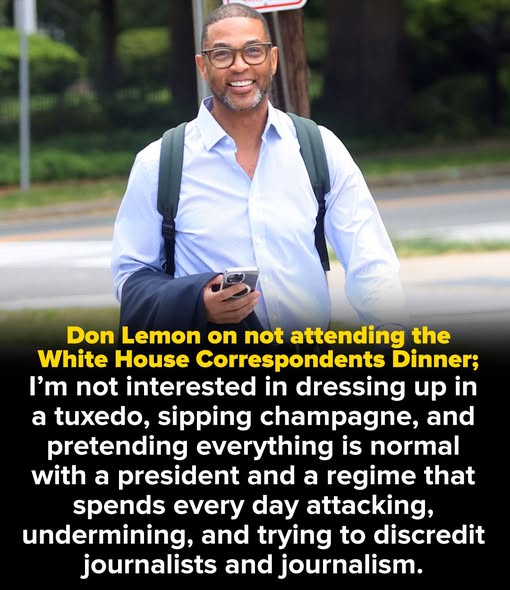
In a candid social media post that has quickly gone viral, veteran journalist Don Lemon expressed his decision not to attend the upcoming White House Correspondents’ Dinner, citing a desire to reject what he describes as performative displays of normalcy amid ongoing political and social upheaval.
The post, which features a straightforward image of text reading, “Don Lemon on not attending the White House Correspondents Dinner; I’m not interested in dressing up in a tuxedo, sipping champagne, and pretending everything is normal,” encapsulates Lemon’s stance on the event. Traditionally, the dinner serves as a high-profile opportunity for journalists, celebrities, and political figures to gather in a glamorous setting, often overshadowed by its underlying purpose of fostering media-government relations.
However, Lemon’s decision reflects a growing sentiment among some journalists and critics who view the soirée as disconnected from the realities faced by ordinary Americans, especially in a polarized political climate. Many feel that the event has become more about glitz and glamour than substantive discussions on pressing issues like democracy, misinformation, and social justice.
In his social media statement, Lemon emphasized that his absence isn’t rooted in protest alone but also in a genuine desire to prioritize authenticity over spectacle. “We’re living through times that demand honesty and accountability, not just fancy dresses and champagne toasts,” he wrote. “Sometimes, standing apart from the pomp is the most powerful statement you can make.”
The decision has sparked a wide-ranging debate online. Supporters laud Lemon’s stance as a courageous call for integrity in journalism, praising him for daring to challenge traditions that may now seem out of touch with current realities. Others, however, criticize the move as political posturing, arguing that the dinner remains an important occasion for fostering dialogue and camaraderie within the media and political spheres.
Analysts suggest that Lemon’s stance may reflect a broader shift, especially among younger journalists and public figures, toward more transparent and socially conscious engagement. With increasing scrutiny on the fairness and independence of the press, Lemon’s refusal to partake in the customary festivities underscores a desire among some to reclaim journalistic integrity and reject superficial displays.
As the event approaches, discussions continue across social media platforms, highlighting ongoing tensions between tradition and evolving journalistic values. Whether Lemon’s decision will influence others remains to be seen, but it undeniably marks a moment of reflection within the media community about what the role of journalism should be in challenging times.