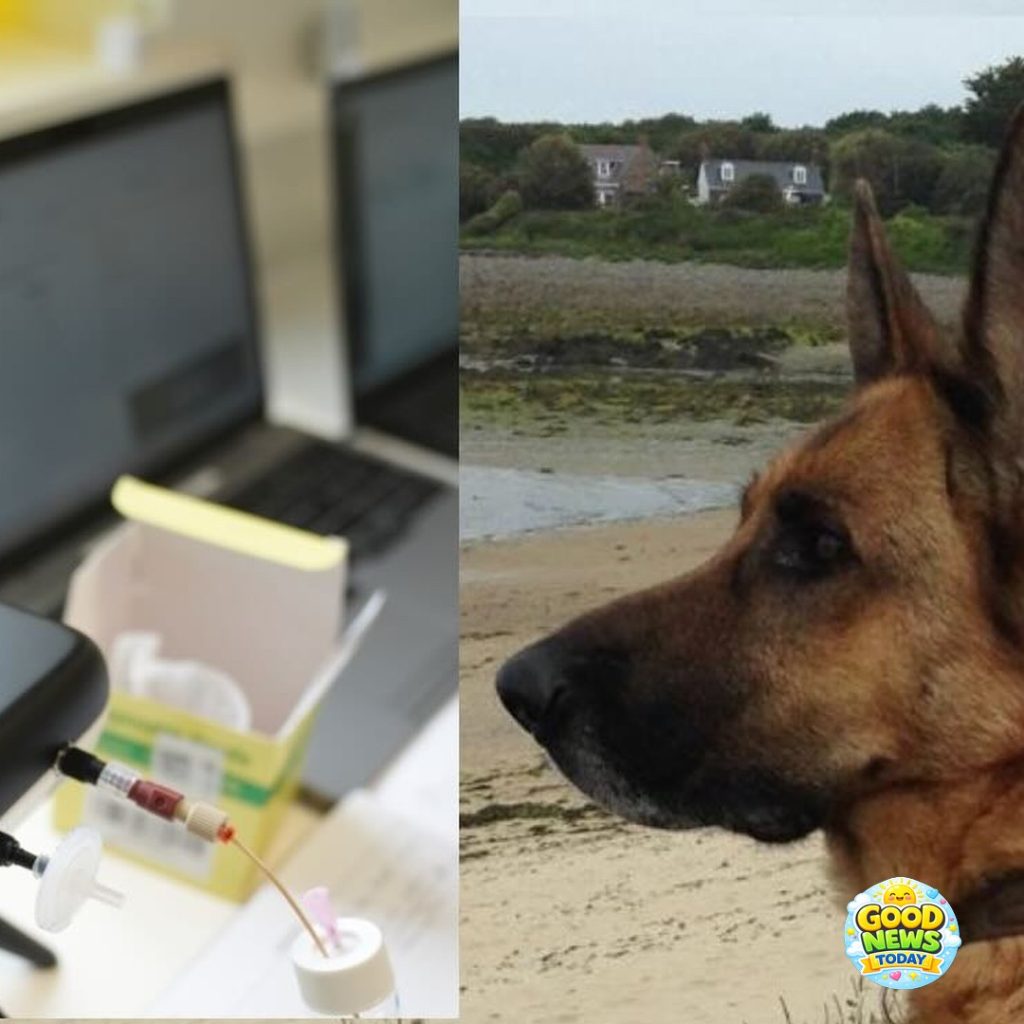
Colleen Ferguson’s life took a remarkable turn thanks to her beloved German shepherd, Inca, who played a crucial role in detecting cancer at its earliest stage. Colleen noticed that for weeks, Inca had been intently sniffing her breath and appearing concerned, which prompted her to investigate further.
Despite Colleen’s visits to the dentist and tests related to her gluten intolerance that all yielded negative results, Inca’s persistent behavior led her to seek a full body scan. The results revealed a “golf ball-sized tumor” in her left lung, diagnosed as stage one cancer.
“She just had this focused intent on my mouth,” shared Colleen, a former science teacher. “She would give me such a look and walk away.” The news of her diagnosis was unexpected, especially since Colleen is a non-smoker and had no noticeable symptoms, apart from feeling unusually tired.
After undergoing surgery to remove the tumor, Colleen was relieved to find she did not require any further treatment or radiation. Now, she is embracing her retirement as a creative writer and published author. “The surgeon told me, ‘we never catch it at stage 1, your dog has saved your life.’ I feel incredibly fortunate. Catching it so early was simply extraordinary. We should all pay attention to our dogs,” she expressed.
Research in the UK supports the idea that dogs possess an exceptional ability to detect cancer through their powerful sense of smell. A nonprofit organization, Medical Detection Dogs, began an innovative study in 2024, training seven dogs—Labradors, cocker spaniels, and a retriever—to identify tumors by sniffing urine samples.
“Dogs have shown us repeatedly that diseases have a specific odor,” stated Claire Guest, CEO and Chief Scientific Officer at Medical Detection Dogs. “We are still exploring whether this is the scent of the tumor itself or the body’s response to it.” Clinical trials have confirmed that dogs can reliably detect various diseases, including prostate cancer, bladder cancer, Covid-19, and even Parkinson’s disease, showcasing their incredible potential when trained.
In an exciting development, scientists are now working on an ‘e-nose’ powered by artificial intelligence to mimic the dogs’ ability to respond to cancer samples. Collaborating with Medical Detection Dogs, Dr. Andreas Mershin, a quantum physicist at MIT, has created an e-nose that employs chemical sensors to “smell” urine samples and identify volatile organic compounds—tiny odor molecules present in the air.
Currently, this innovative e-nose is undergoing testing with 500 urine samples from patients at Milton Keynes University Hospital near London, including those with prostate cancer and healthy individuals, to assess its capability to accurately detect cancer.
With ongoing advancements in this field, the fusion of canine instincts and cutting-edge technology promises a future where early cancer detection could save even more lives.