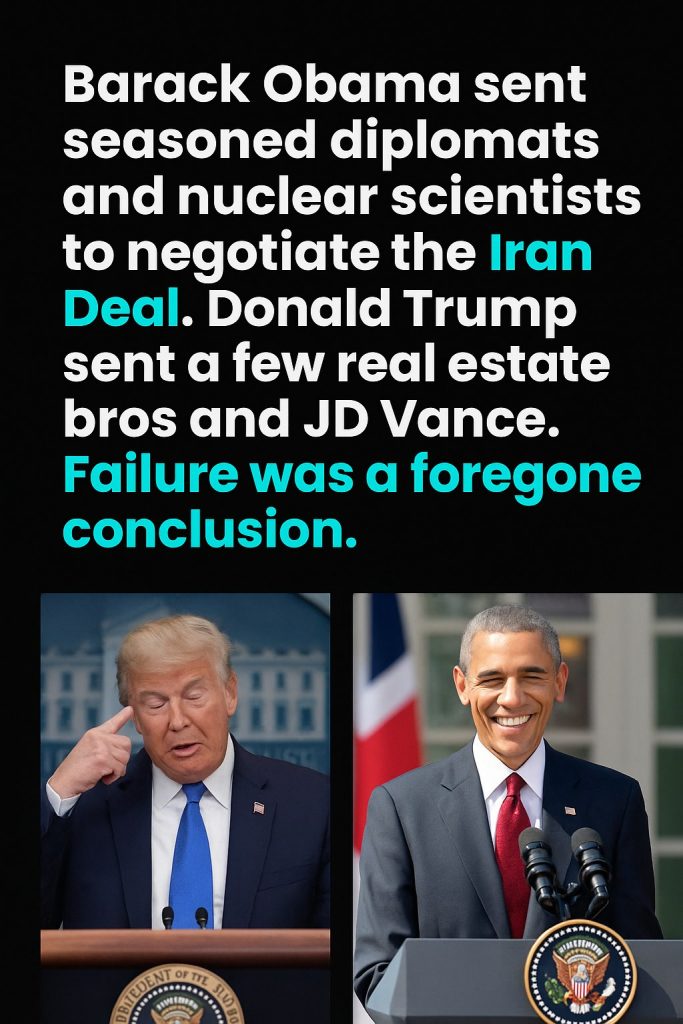
Recent social media chatter has reignited debate over the contrasting approaches the Obama and Trump administrations took in handling the Iran nuclear deal negotiations. A popular meme highlights the disparity by noting that former President Barack Obama dispatched seasoned diplomats and nuclear scientists to negotiate with Iran, while Donald Trump’s team reportedly included “a few real estate bros and JD Vance.”
This biting comparison sums up a broader discussion about the professionalism, expertise, and experience involved in delicate diplomatic negotiations, especially those related to nuclear non-proliferation and international security.
The Obama Approach
Under Obama’s leadership, the negotiations that led to the Joint Comprehensive Plan of Action (JCPOA) — the Iran nuclear deal reached in 2015 — were spearheaded by expert diplomats and nuclear scientists. This included then-Secretary of State John Kerry and a host of negotiators with deep backgrounds in diplomacy and nuclear policy.
The goal was to prevent Iran from developing nuclear weapons capability by imposing strict limits and verification protocols on Iran’s nuclear program. The team brought in not only diplomatic finesse but also technical expertise to understand the complexities of nuclear science, which was crucial in crafting enforceable terms.
The Trump Administration’s Team
When President Donald Trump took office, he decisively withdrew the United States from the JCPOA in 2018, calling the deal a “disaster” and “one-sided.” However, criticism has been voiced over the composition of personnel involved in US-Iran policy and negotiations under Trump.
The referenced social media post points out that instead of seasoned diplomats and scientists, Trump’s team allegedly included businessmen with no traditional diplomatic experience — sometimes referred to as “real estate bros” — as well as public figures like JD Vance, an author and venture capitalist turned political figure, who were viewed as outsiders to diplomatic protocol.
While Trump’s administration pursued a maximum pressure campaign through sanctions, critics argue this approach lacked the nuanced understanding required for complex nuclear negotiations, raising concerns about long-term strategy and diplomatic credibility.
The Broader Implications
This meme captures a critical question about foreign policy: How essential is professional expertise in dealing with nuclear diplomacy? The stakes surrounding the Iran deal are enormous — they involve not only US security but global peace.
The experience of seasoned diplomats and scientists arguably builds trust, ensures precise understanding of technical issues, and facilitates engagement with international partners and adversaries alike. By contrast, relying heavily on political outsiders or business figures may marginalize expertise, potentially weakening negotiation outcomes.
As the conversation around US-Iran relations continues, this contrasts shows the need to balance political perspectives with expertise to effectively manage sensitive international agreements.
At its heart, the debate reflects fundamental tensions about how America should wield its diplomatic power in an increasingly complex global environment.
Where to Learn More
- Joint Comprehensive Plan of Action (JCPOA) – U.S. Department of State
- The Iran Nuclear Deal: Background and Issues – Council on Foreign Relations
- What the US Withdrawal from the Iran Nuclear Deal Means – Brookings Institution
- Trump’s Iran Strategy: Bringing a Business Mind to Diplomacy – The New York Times