
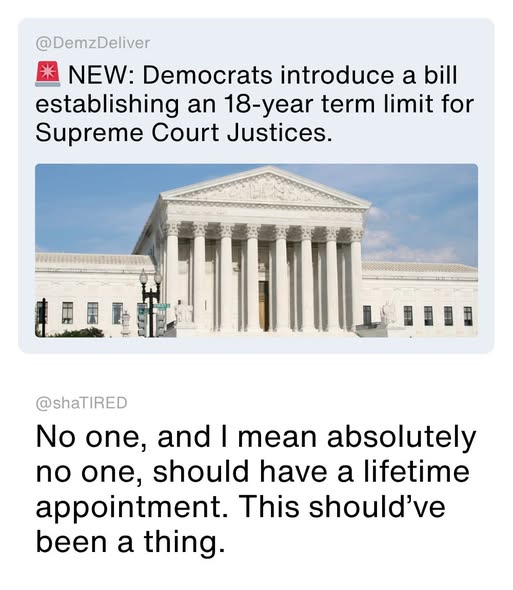
In a groundbreaking move that has sparked widespread debate across the political spectrum, Democratic lawmakers have introduced a bill aiming to impose an **18-year term limit** on **Supreme Court Justices**. This proposal seeks to address long-standing concerns about the influence of lifetime appointments, perceived bias, and the polarization often associated with federal judicial vacancies.
The bill, announced via social media and legislative channels, sets out a plan for justices to serve fixed 18-year terms, after which they would be required to step down or face mandatory retirement. Proponents argue that implementing such limits would promote judicial accountability, ensure fresh perspectives, and reduce the potential for partisan influence that can extend over decades.
“No one, and I mean absolutely no one, should hold a lifetime appointment that spans multiple presidential administrations and political eras,” stated one of the bill’s sponsors. “The judiciary must reflect the evolving values of our society and be subject to renewal,” they added during a press conference yesterday.
The idea of term limits for Supreme Court justices is not new, but it has gained renewed traction amid a highly polarized political climate and recent high-profile nominations. Critics of lifetime appointments argue that justices serving for decades can lead to an erosion of democratic accountability, with some justices ruling on issues that impact society long after changing political ideologies have emerged.
Conversely, opponents warn that imposing strict term limits could undermine judicial independence, potentially forcing justices to make rulings based on political pressures rather than constitutional principles. They also raise concerns about the potential for increased politicization during appointment processes, as justices might be viewed as “short-term fixtures” rather than impartial arbiters of law.
Interestingly, the bill also generates a broader conversation about the future of judicial reform in the U.S. legislative arena. While no law has yet passed, this proposal marks a historic development in efforts to reshape the Supreme Court’s long-term composition and influence.
As the bill makes its way through congressional committees, public opinion is divided, with social media users voicing a mix of support and skepticism. Some argue that term limits could revitalize the court, enhancing its legitimacy in the eyes of citizens, while others insist that lifetime tenure safeguards judicial independence from political pressure.
Regardless of the outcome, the introduction of this bill signals a significant shift in how Americans and lawmakers view the role and tenure of the nation’s highest judicial body. Whether it gains momentum or faces opposition, it underscores an ongoing debate about the balance of power, accountability, and the future of judicial independence in the United States.
Where to Learn More
- New Democratic Bill Calls for 18-Year Limit on Supreme Court Justices – The New York Times
- Democrats Introduce Major Bill to End Lifetime Appointments for Supreme Court – CNN
- A New Era? Lawmakers Push for Judicial Term Limits Amid Political Debate – The Washington Post
- Should Supreme Court Justices Have Term Limits? – Brookings Institution