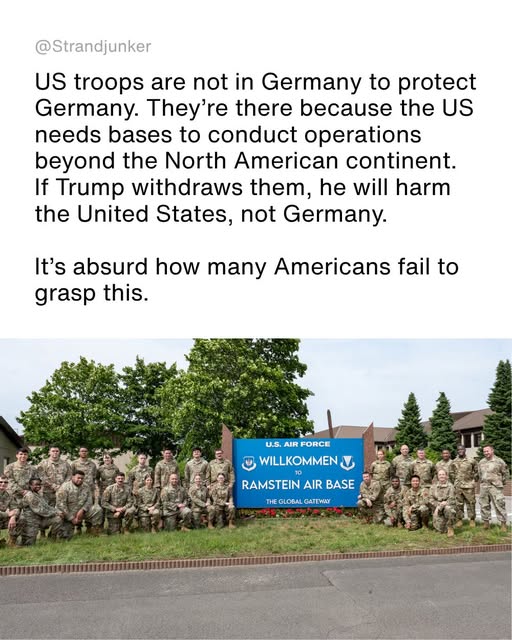
In recent social media buzz, a caption claiming that “US troops are not in Germany to protect Germany but to conduct operations beyond North America” has sparked widespread debate and confusion. While the statement appears to challenge conventional perceptions of military alliances, it’s crucial to understand the broader strategic context behind U.S. troop deployments in Europe.
Many observers and defense experts agree that the presence of American forces in Germany and other European nations serves multiple strategic objectives—not solely the defense of host countries. Historically, U.S. military bases in Europe trace back to the aftermath of World War II and the Cold War era, serving as vital components of NATO’s collective defense system and as launch pads for global operations.
Jennifer Smith, a defense analyst at the Center for Strategic and International Studies, explains, “U.S. forces stationed in Europe are primarily aimed at deterring aggression, maintaining stability within the region, and providing rapid deployment capabilities for crises worldwide. These bases enable the U.S. to project power globally, beyond the American continent.”
The claim that these bases are solely for offensive operations beyond North America overlooks the defensive roles and the importance of strategic deterrence. NATO, a cornerstone of European security, relies heavily on the presence of U.S. troops to ensure mutual defense commitments. This arrangement benefits both the U.S. and allied nations, fostering stability and peace in a historically volatile region.
Moreover, the logistics of global military operations often require strategic positioning around the world. U.S. bases in Europe act as pivotal hubs for humanitarian missions, counter-terrorism operations, and contingency plans across Africa, the Middle East, and Asia. Without these bases, rapid response to emerging crises would be significantly hampered.
It’s worth noting that discussions around foreign troop presence are complex and often politicized. While some critics argue that the U.S. should reduce troop commitments abroad, the prevailing consensus within defense circles emphasizes the importance of forward-deployed forces for national security and strategic advantage.
In summary, the idea that U.S. troops in Germany are only there to serve American interests beyond the North American continent simplifies a sophisticated and multifaceted military strategy. These bases are integral to both NATO’s defense posture and the U.S.’s ability to respond globally.