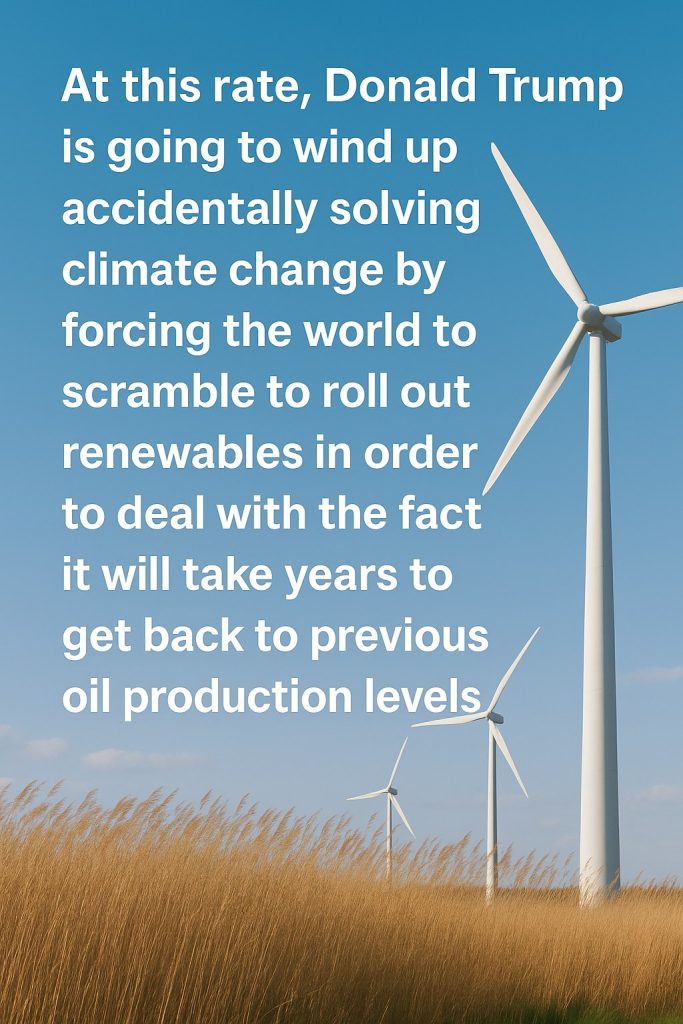
In an ironic twist of fate, some social media users are suggesting that former President Donald Trump’s approach to climate policy might inadvertently accelerate the world’s shift to renewable energy. A viral post humorously noted, “At this rate, Donald Trump is going to wind up accidentally solving climate change by forcing the world to scramble to roll out renewables.” Though originally meant as satire, this commentary touches on a deeper discussion about the complex dynamics of climate action and political influence.
During his tenure, Donald Trump was famously skeptical of mainstream climate science and rolled back numerous environmental protections in favor of expanding fossil fuel industries. His administration pulled the United States out of the Paris Climate Agreement — a decision that raised global alarm about America’s commitment to fighting climate change. However, this contentious stance arguably galvanized many states, cities, corporations, and countries to double down on their climate commitments, underscoring a phenomenon political scientists and environmental analysts sometimes refer to as the “backlash effect.”
When a prominent figure or government weakens climate policies, it can paradoxically stimulate stronger, more aggressive initiatives elsewhere. For example, in response to federal rollbacks under the Trump administration, California ramped up its renewable portfolio standards and introduced ambitious carbon neutrality goals by 2045. Many major corporations, frustrated by the lack of federal leadership, announced independent commitments to transition to 100% renewable energy.
Globally, Trump’s climate skepticism arguably heightened international urgency. After the U.S. exit from Paris in 2017, other nations swiftly reinforced their climate pledges, eager to maintain momentum without the world’s largest economy pulling back. This helped stimulate innovations in solar, wind, battery storage, and even emerging technologies like green hydrogen, as investments poured into sustainable infrastructure to meet rising demand for alternatives to fossil fuels.
Furthermore, public opinion has dramatically shifted during and after Trump’s presidency. Surveys indicate rising awareness and support for climate action among Americans, particularly younger generations. This social momentum has translated to pressure on politicians, regardless of party lines, to prioritize renewable energy and sustainable practices.
Ironically, then, what began as an administration broadly critiqued for dismissing climate science may have accelerated the very renewable energy transition it sought to undermine. The scramble to “pick up the slack” in climate leadership has spurred innovation, policy, and investment at multiple scales. The United States rejoined the Paris Agreement under President Joe Biden, amplifying these efforts further and signaling a renewed national commitment to tackling climate change.
While it is an oversimplification to say that Trump “solved” climate change, the viral social media quip reflects a curious reality: adversity in climate policy can spur unforeseen resilience and accelerated progress.
As the world races to limit global warming to 1.5 degrees Celsius above pre-industrial levels, the interplay between politics and climate action remains complex and sometimes paradoxical. The legacy of Trump’s climate policies may well be measured not just in setbacks, but in the unexpected responses they inspired around the globe.
Where to Learn More
- How Trump’s Climate Denial Changed the US Global Climate Role – The New York Times
- Climate Action in the Trump Era: A Retrospective – Brookings Institution
- Biden’s Return to the Paris Agreement and Its Impact – CNN
- Renewable Energy Market Update – International Energy Agency
- Global Climate Policies Tracker – Carbon Brief