
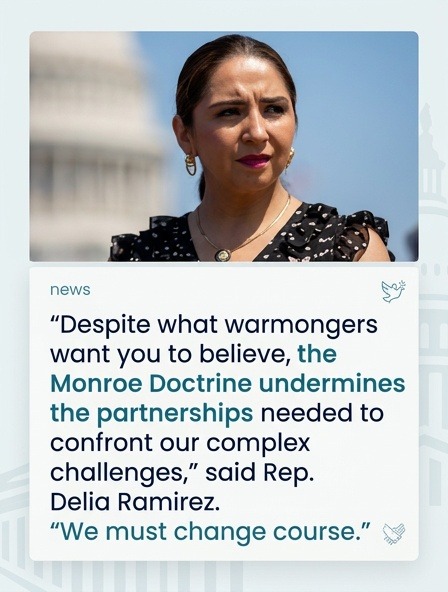
In a bold and stirring speech that’s resonating across social media, Congresswoman Delia Ramirez has called for a reevaluation of U.S. foreign policy frameworks, specifically criticizing the long-standing Monroe Doctrine. She asserts that the doctrine, historically used to justify American dominance in the Western Hemisphere, now hampers the nation’s ability to build vital international partnerships needed to confront today’s complex global challenges.
“Despite what warmongers want you to believe, the Monroe Doctrine undermines the partnerships needed to confront our complex challenges,”” Ramirez declared in a statement that has quickly gone viral amid ongoing debates over America’s approach to foreign policy. Her words reflect a growing chorus among progressive lawmakers and foreign policy advocates calling for a shift away from one-sided dominance towards a more collaborative, multilateral approach.
The Monroe Doctrine, articulated by President James Monroe in 1823, was originally designed to prevent European interference in the Americas. While it played a crucial role during American expansionism in the 19th century, critics warn that its legacy has fostered a culture of unilateralism and interventionism. Today, global challenges such as climate change, cybersecurity threats, and economic instability demand international cooperation—not confrontation or dominance.
Ramirez’s stance aligns with a broader movement to recalibrate U.S. foreign policy. She emphasizes that fostering genuine, equitable partnerships with Latin American nations and other international stakeholders is essential for addressing crises like migration, drug trafficking, and regional instability. “Our neighbors are not adversaries,” she continued. “We need a policy that promotes unity, understanding, and shared responsibility—a stark contrast to the divisive legacy of the Monroe Doctrine.”
This call to change comes amid increasing criticism of current foreign policy strategies, especially from lawmakers advocating for diplomacy over military intervention. Critics argue that the enduring influence of the Monroe Doctrine perpetuates a narrative of American exceptionalism that alienates partners and hampers collaborative efforts on issues like climate resilience and public health crises.
Politically, Ramirez’s remarks are gaining traction among a diverse coalition eager to see the U.S. embrace a more inclusive, multilateral approach. Experts suggest that shifting away from the Monroe Doctrine’s traditional stance could pave the way for stronger alliances, regional stability, and a more sustainable and effective foreign policy that reflects modern realities.
As debates continue, Ramirez’s call for a reassessment of foundational American policies sparks an important conversation about the future direction of U.S. international relations—one that prioritizes partnership and shared progress over unilateral dominance.
Where to Learn More
- Congresswoman Ramirez Addresses Foreign Policy Shifts – C-SPAN
- Rethinking U.S. Foreign Policy: Moving Beyond the Monroe Doctrine – Foreign Policy Magazine
- How the Monroe Doctrine Impacts Modern Diplomacy – The Washington Post
- Congresswoman Delia Ramirez Calls for Policy Change – HuffPost