
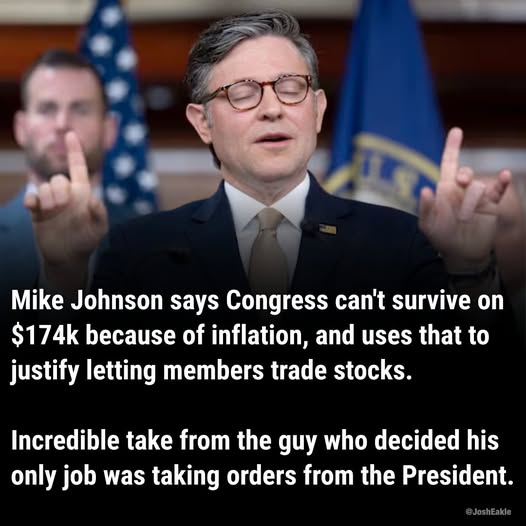
In a viral social media moment that has sparked widespread debate, Congress member Mike Johnson made a bold assertion: the $174,000 salary of legislators is insufficient to survive in today’s economy, thereby justifying their continued ability to trade stocks while in office. The statement, circulated widely on platforms like Twitter and Facebook, has ignited controversy and raised questions about the ethics and practicalities of congressional stock trading amid economic inflation.
Johnson’s claim appears to hinge on the notion that inflation has rendered a six-figure income inadequate, thus enabling members of Congress to justify engaging in financial activities, such as stock trading, that often come under scrutiny. The image, which displays Johnson’s quote, reads: “Mike Johnson says Congress can’t survive on $174k because of inflation, and uses that to justify letting members trade stocks.”
While the statement appears to be an oversimplification, it taps into ongoing debates about Congress’s exemption from certain financial regulations that apply to the general public. Currently, members of Congress are allowed to trade stocks, bonds, and other securities, often with little transparency or oversight, leading critics to accuse lawmakers of potential conflicts of interest.
Many social media users have responded with outrage, questioning how a statement like this can be taken seriously, especially as inflation rates have risen significantly over the past few years. Critics argue that rather than using inflation as a justification, lawmakers should be working to reform financial regulations and eliminate potential conflicts of interest.
In response to the viral post, political analysts have emphasized that the salary of Congress members is widely considered insufficient when compared to the demands and costs of modern life, but most also argue that this does not necessarily justify insider trading or financial favoritism. Rather, it highlights the broader need for reform in congressional ethics and transparency.
This incident underscores the ongoing debate about the integrity of stock trading among lawmakers. The practice has been under increased scrutiny, with calls for banning or restricting stock trades by politicians to prevent conflicts of interest and restore public trust.
As discussions continue, many are calling for lawmakers to focus on addressing economic issues directly—such as inflation and wages—through policy changes rather than rationalizing questionable activities. There’s a growing demand for transparency, ethics reforms, and oversight to ensure that elected officials serve the public interest, not their personal financial gain.
Where to Learn More
- Congress, Ethics, and the Stock Trading Dilemma – CNN
- Calls Grow to Ban Stock Trading for Members of Congress – The New York Times
- Why Congress Needs a Stock Trading Ban Now – The Washington Post
- Reforming Congressional Financial Ethics – Brookings Institution