
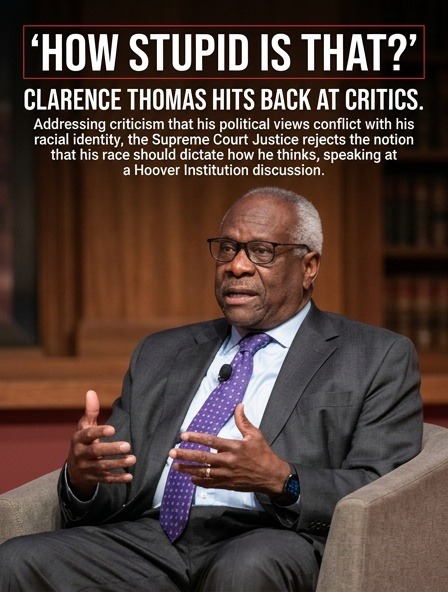
The ongoing debate over identity and politics took a sharp turn this week as Supreme Court Justice Clarence Thomas publicly pushed back against critics questioning whether his political beliefs are influenced by his race. During a candid discussion hosted by the Hoover Institution with interviewer Peter Robinson, Thomas sharply criticized the notion that his race should dictate his views or decision-making on the bench.
“How stupid is that?” Thomas asks rhetorically, addressing the widespread assumption that because he is Black, his legal philosophy and ideology are inherently aligned with a racial identity. He emphasized that such stereotypes are not only dismissive but fundamentally flawed, arguing that individuals should be judged by their ideas and principles—not their skin color.
“The idea that I somehow think or believe in a way just because I’m Black misses the entire point of the American system,” Thomas states. “It assumes every Black person is the same, which is not only inaccurate but reductive.” He went on to say that his personal journey—including his rise from a challenging childhood in Georgia to the highest court in the land—refutes the simplistic notion that race should predetermine one’s beliefs or choices.
Critics have long debated whether Justice Thomas’s conservative judicial philosophy conflicts with the expectations associated with his racial identity. Some have claimed that his legal positions, which often align with traditional Republican views on issues such as affirmative action, LGBTQ rights, and constitutional interpretation, are at odds with the experiences of many in the Black community. Thomas dismisses such claims, asserting that political ideology is a matter of individual conviction, not racial obligation.
“It’s dangerous to presume my beliefs are somehow dictated by my race,” he adds. “That kind of thinking undermines the very principles of independence and individual rights that this country was founded on.”
The Justice’s remarks come at a time when discussions around identity politics are more prevalent than ever, fueling polarized opinions. Supporters argue that Thomas’s defiance of racial stereotypes is a vital reminder of the importance of individual agency, while critics contend that race still plays a significant role in shaping political identities and choices.
In the broader context, Thomas’s outspoken stance underscores a philosophical debate about the role of race in American political and judicial life—a debate that terus unresolved after centuries of social upheaval. His willingness to speak openly about the issue not only reinforces his reputation as a staunch defender of individualism, but also raises questions about how race and politics intersect in the highest levels of American government.
Where to Learn More
- Clarence Thomas rebuffs racial stereotypes in recent remarks – Washington Post
- Analysis of Clarence Thomas’s stance on race and judicial independence – The New York Times
- Profile of Clarence Thomas’s journey and judicial philosophy – History.com
- Legal experts discuss Thomas’s remarks on race and politics – CNN