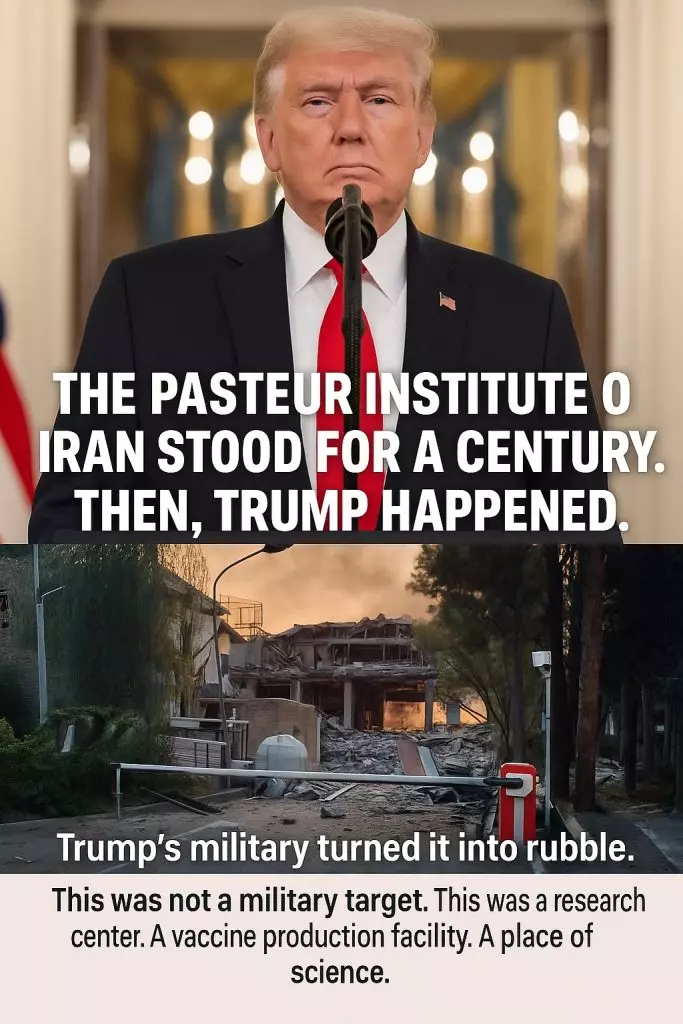
For over 100 years, the Pasteur Institute of Iran stood as a beacon of scientific progress and public health in the Middle East. Established in the early 20th century and connected globally as a part of the International Pasteur Network, the institute was renowned for its pioneering vaccine research and production. It played a crucial role in studying diseases and pioneering methods to contain them, serving as a cornerstone of medical science in the region.
Yet, this historic institution, a symbol of knowledge and humanitarian effort, was reduced to rubble in recent military strikes orchestrated by forces aligned with former U.S. President Donald Trump’s administration. Iran’s Ministry of Health decried the assault as “a direct assault on international health security,” emphasizing that it violates the principles enshrined in the Geneva Conventions, which protect civilian infrastructure, especially facilities dedicated to health and research.
This attack was not just an act of war; it was a targeted demolition of scientific progress. The Pasteur Institute was neither a military base nor a weapons factory—it was a vaccine production hub and a research center dedicated to saving lives. The destruction thus sent shockwaves beyond mere geopolitical conflict, striking at the very heart of global health and the fight against infectious disease.
Unfortunately, this devastation fits into a broader, disturbing pattern. Just days earlier, the Daro Bakhsh Pharmaceutical Factory was bombed, crippling local medicine production. Prior to that, the Iran University of Science and Technology, another institution pivotal to education and innovation, was targeted. Two schools were struck on the same day, one with a weapon never before used on humans. Even the World Health Organization’s office in Tehran suffered damage from nearby attacks, with shattered windows bearing silent testimony to the violence.
Israeli forces also contributed to the destruction, bombing an Iranian pharmaceutical company—an act Iran’s foreign minister condemned as “openly and unashamedly bombing pharmaceutical companies.” Across the board, essential pillars of Iranian society, including schools, universities, hospitals, and pharmaceutical manufacturers, have been systematically targeted and erased.
Donald Trump himself had ominously proclaimed a plan to bomb Iran “back to the Stone Ages where they belong.” This offensive reveals what that threat truly entailed—not abstract rhetoric, but a methodical dismantling of a nation’s scientific and educational infrastructure, building by building, laboratory by laboratory, classroom by classroom.
The destruction of the Pasteur Institute reverberates far beyond Iran’s borders. A century of medical research, thousands of scientific discoveries, and vital vaccine production lines have vanished, undermining global health efforts at a moment when the world can least afford such setbacks. This is not just collateral damage; it is a catastrophic blow to human knowledge and international cooperation in disease prevention.
As global leaders and humanitarian organizations call for accountability, the world must recognize that true security is built on the foundations of science, education, and health—not on the ruins of them. The legacy of the Pasteur Institute should inspire resolve to protect, rebuild, and recommit to peace and progress.
Where to Learn More
- Iran Ministry of Health Condemns Attack on Pasteur Institute – World Health Organization
- Iran Blames Israel, US for Bombing Pharmaceutical Factory – Reuters
- Century-Old Medical Institute Destroyed in Iran Amid Conflict – Al Jazeera
- Attacks on Civilian Infrastructure in Iran Violate International Law – Human Rights Watch