
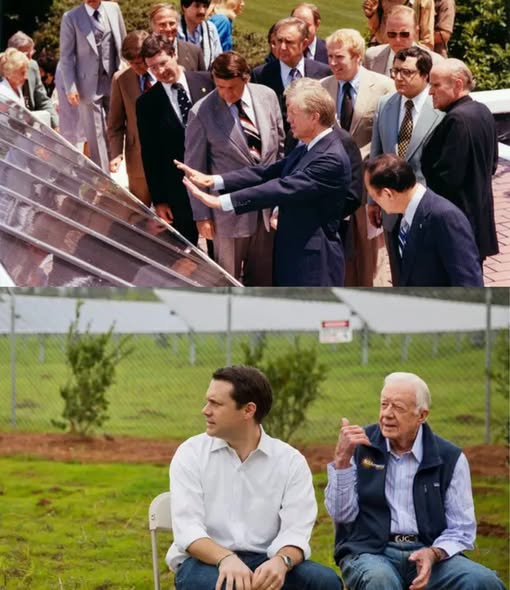
As the world grapples with the urgent need to transition to clean energy, history offers a reminder of a President who championed solar power long before it became fashionable. Jimmy Carter, who passed away in December 2024 at the age of 100, left behind a legacy not just as a statesman but as an early advocate for renewable energy.
In 1979, during the Arab oil embargo, Carter made a historic move by installing 32 solar panels atop the White House, aiming to reduce dependency on foreign oil and promote sustainable energy solutions. Although those panels were dismantled during Reagan’s presidency just two years later, their legacy endured. Today, some of those original panels are preserved in a museum in Dezhou, China, symbolic of America’s first solar step.
Fast forward to present-day Georgia, where Carter’s commitment to solar energy took tangible form in his own backyard. On what used to be soybean rows in Plains, Georgia, a 3,852-panel solar farm quietly hums, producing about 1.3 megawatts of electricity on good days—equivalent to burning roughly 3,600 tons of coal annually. This solar farm supplies power to the town of just 727 residents, more than half of whom now get their electricity from the very field Carter built at age 92, demonstrating a lasting dedication to community and sustainability.
His foresight—turning energy policy into tangible community benefit—stands in stark contrast to modern national trends. Currently, political focus has shifted away from clean energy investments. Under recent administrations, large-scale projects face delays and cuts, with Bloomberg Tax projecting a 41% drop in clean-energy installations after 2027. Meanwhile, policies like the “One Big Beautiful Bill” have redirected funds from family-support initiatives to questionable projects like Trump’s costly renovation of the East Wing of the White House, now approaching a $400 million bill.
American consumers are increasingly burdened, with the average working family losing roughly $9,000 in savings due to policy choices that favor fossil fuels and delay renewable development. The national grid grows dirtier, and climate change accelerates, while oil and gas executives celebrate record earnings. Amid this turmoil, Carter’s legacy serves as a reminder that a different path was once possible—a path rooted in sustainability, community resilience, and long-term planning.
Today, as we face a planet that’s heating at alarming rates, we are reminded that leadership can shape a sustainable future. Jimmy Carter’s life shows us that individual acts—like installing solar panels on the White House or turning a peanut farm into a clean energy hub—can leave a lasting legacy. The question is: Do we want to reclaim that vision and embrace the clean energy future he envisioned decades ago?
We had a president once who took proactive steps toward sustainability, and now it’s up to us to decide if we’ll follow his example. The future of the planet—and our communities—depends on it.
Where to Learn More
- Remembering Jimmy Carter’s Solar Legacy – NPR
- Jimmy Carter’s Solar Panels at the White House – U.S. Department of Energy
- Bloomberg: Future of Clean Energy Installations
- The Lasting Impact of Carter’s Solar Initiatives – Solar Power World