
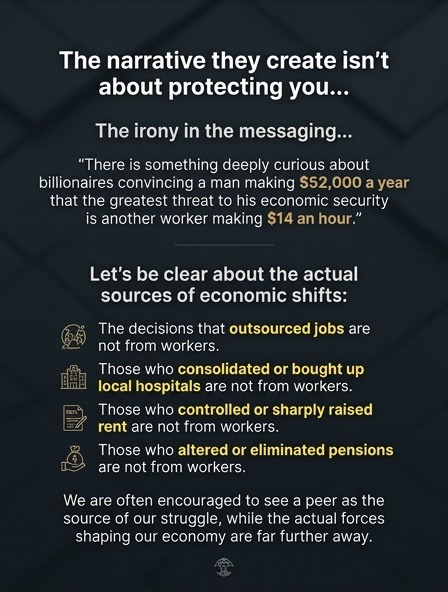
In a striking display of social commentary making waves on social media, a thought-provoking message has gone viral: “There is something deeply funny about billionaires convincing a man making $52,000 a year that the greatest threat to his freedom is another worker making $14 an hour.”
This sharp observation highlights an enduring paradox in modern economic and political discourse. While enormous wealth concentrates in the hands of a handful of billionaires, the narrative that dominates many political debates and media outlets tends to focus on the supposed threats posed by fellow workers earning modest wages. The irony is hard to ignore: those with the most to lose from economic inequality and corporate monopolies are often convinced by the very wealthiest that their real adversary is another worker trying to earn a living wage.
At the heart of this dynamic lies the amplified influence of wealth in shaping public perception. Campaigns funded by billionaires and corporate interests often cast dissenters—whether minimum-wage workers, union organizers, or activists—as threats to economic stability or personal freedom. Meanwhile, billionaires argue that their wealth is essential for innovation, job creation, or economic growth, framing economic disparities as a necessary byproduct of a thriving free market.
However, critics point out that this narrative serves a powerful purpose: diverting attention from systemic inequalities and placing blame on workers themselves. The social media message cleverly exposes how the wealthy and their representatives foster a false sense of division among workers earning different wages. By doing so, they undermine collective efforts toward fair wages, labor rights, and economic reform.
This divide-and-conquer strategy isn’t new, but its present-day potency is amplified by social media platforms that allow quick dissemination and amplification of such messages. Meanwhile, policy debates often ignore the root causes of economic inequality—corporate tax avoidance, automation, and deregulation—favoring instead narratives that pit workers against each other.
The viral quote encourages reflection on who truly benefits from the perception of threat. The real danger to economic mobility and personal freedom, many argue, is the concentration of wealth and power at the top—an issue often overshadowed by rhetoric that seeks to divide the working class.
As conversations around wages, workers’ rights, and corporate influence continue to evolve, it’s vital for the public to recognize this irony and question the narratives fed by those with vested interests. Unity among workers and a push for systemic reform might be the only way to challenge the real threats to our collective freedom.
Where to Learn More
- The Growing Wealth Gap and Its Impact on Society – Economic Policy Institute
- How Billionaires Push Narratives to Divide Workers – The Nation
- Debunking Myths About Wealth and Economic Prosperity – Balance.org
- Addressing Economic Inequality in America – Brookings Institution