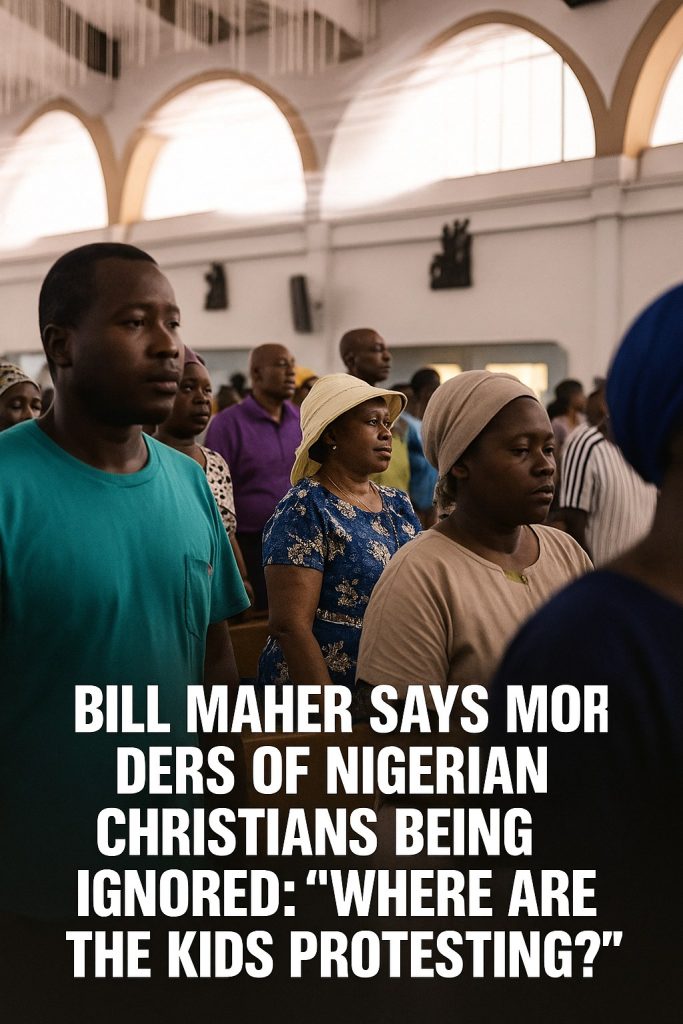
On Friday, comedian and commentator Bill Maher addressed a glaring omission in the public discourse surrounding global humanitarian crises: the silence over the brutal murders of Nigerian Christians. Speaking on his popular HBO show, Maher slammed the lack of mass protests and awareness about the pervasive violence committed by Islamic extremist groups in Nigeria, which has seen over 100,000 Christians killed since 2009.
“They’ve burned 18,000 churches. This is so much more of a genocide attempt than what is going on in Gaza,” Maher proclaimed, calling attention to what he describes as a gross neglect of the plight faced by Nigerian Christians. His remarks ignited a flurry of discussion across social media platforms, drawing both support and criticism from viewers.
The statistics Maher presented paint a stark picture: since 2009, violence against Christians in Nigeria has escalated dramatically, primarily attributed to the activities of Boko Haram and armed Fulani herdsmen. These groups have consistently targeted Christian communities, leading to large-scale displacement and human rights violations. According to numerous reports, the situation has led many to describe the violence as a form of ethnic cleansing, intertwining religious and cultural dimensions that complicate the narrative for many outside observers.
While protests and global attention have surged for various geopolitical crises around the world, Maher expressed his frustration that the plight of Nigerian Christians remains largely ignored. “Where are the kids protesting? Where’s the outrage?” he asked, urging younger generations to recognize and respond to what he termed a genocide.
The response to Maher’s commentary has been a mixture of acclaim and backlash, with some praising his efforts to shine a light on issues that often slip through the cracks of mainstream media. Conversely, critics have accused him of downplaying other humanitarian issues, using divisive rhetoric in a complex discussion about violence and suffering globally. Nonetheless, what is undeniable is that Maher’s words have prompted many to reconsider their focus on humanitarian efforts and the visibility of suffering faced by various communities.
Human rights organizations have long voiced concerns over the violence against Christians in Nigeria, advocating for international attention and intervention. Despite these calls for help, many observers believe that the media’s focus often shifts towards crises that align more closely with current geopolitical narratives, leaving vulnerable populations like Nigerian Christians to remain in the shadows.
As discussions regarding Maher’s statements continue, one thing is clear: his outrage reflects a wider call for awareness and action concerning the ongoing human rights violations in Nigeria. The challenge remains for the global community to recognize that suffering, regardless of religious background, deserves equal attention and response.
Where to Learn More
- Nigerian Christian persecution: A silent genocide? – BBC News
- Human Rights Watch: Nigeria Country Report – Human Rights Watch
- The persecution of Christians in Nigeria – CNN