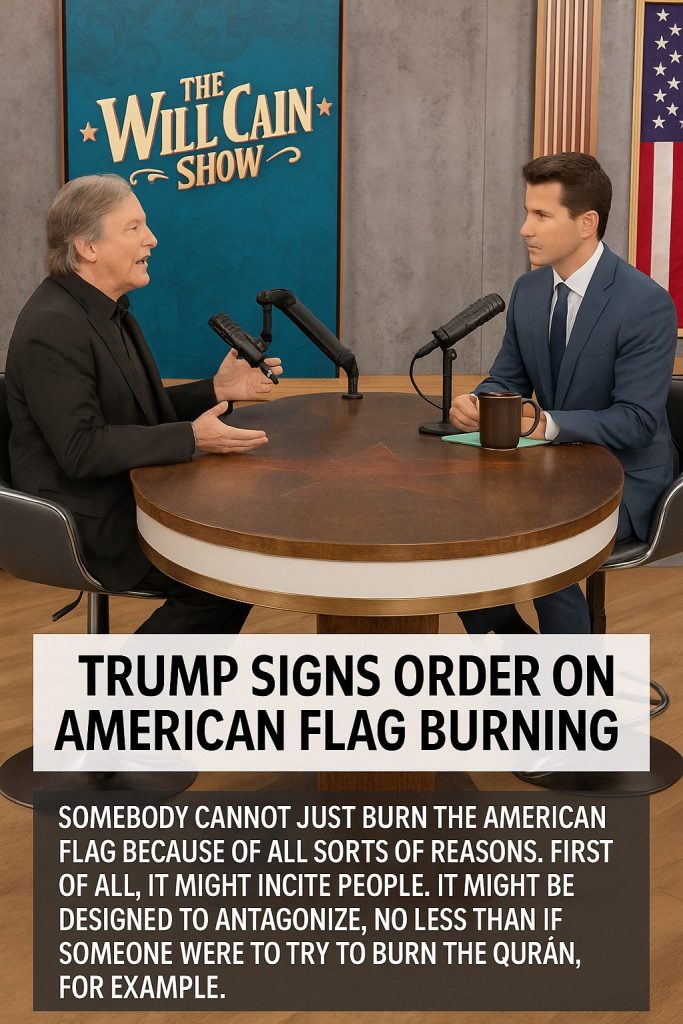
Controversy has erupted following recent comments by Barak Lurie, a commentator on the Will Cain Show, regarding the act of burning the American flag. Lurie argued that burning the flag is not a simple expression of free speech but an act that “might incite people” and could be intended to antagonize, drawing a provocative comparison to burning the Quran.
During the April 2024 broadcast, Lurie stated, “Somebody cannot just burn the American flag because of all sorts of reasons. First of all, it might incite people. It might be designed to antagonize, no less than if someone were to try to burn the Quran.” These remarks have reignited a long-standing debate about the boundaries of symbolic speech, patriotic respect, and the limits of free expression under U.S. law.
Flag burning has been a flashpoint in American public discourse for decades. The U.S. Supreme Court’s landmark 1989 decision in Texas v. Johnson upheld flag burning as protected speech under the First Amendment, establishing that the government cannot prohibit such expression solely because it is offensive or disagreeable to many.
Lurie’s comments challenge this legal precedent by underscoring potential social consequences, such as public unrest or deliberate provocation. His remarks imply that certain symbolic acts, especially those targeting national emblems or sacred symbols of identity, might warrant a different kind of scrutiny due to their potential to incite conflict.
The analogy to burning the Quran adds another sensitive dimension. The Quran is revered by millions globally, and its desecration has often led to violent protests worldwide. Lurie suggested that, like the Quran, the American flag is not just a piece of cloth but a symbol that carries deep emotional and cultural weight — and damaging it can be perceived as an attack on identity and community.
This perspective has drawn both support and criticism. Supporters argue that actions which intentionally antagonize and inflame tensions should be restricted in the interest of public safety and respect for national unity. Critics, however, maintain that free speech is a cornerstone of American democracy precisely because it protects unpopular and offensive expressions, even when they spark discomfort or outrage.
The ongoing discourse also raises questions about where society should draw the line between protected speech and acts that may provoke violence or hate. Legal scholars caution that limiting symbolic speech risks a slippery slope where subjective interpretations of insult or offense could lead to censorship and erosion of civil liberties.
Recent years have seen a resurgence in visible protests involving flags and other national symbols, reflecting broader societal divisions. As the nation navigates these tensions, debates like those sparked by Lurie’s statements highlight the complex interplay between freedom, symbolism, and social cohesion.
In response to the controversy, free speech advocates emphasize education and dialogue over restrictions, advocating for robust forums to discuss difficult issues rather than suppress provocative acts. Meanwhile, some policymakers have renewed calls for legislation that would criminalize flag desecration, though such proposals face constitutional challenges.
Ultimately, the conversation ignited by Barak Lurie on the Will Cain Show is a reminder that symbols like the American flag evoke powerful emotions and remain at the heart of debates about identity, rights, and respect in a deeply polarized society. How America reconciles the tension between protecting national symbols and preserving free expression continues to be an enduring question.