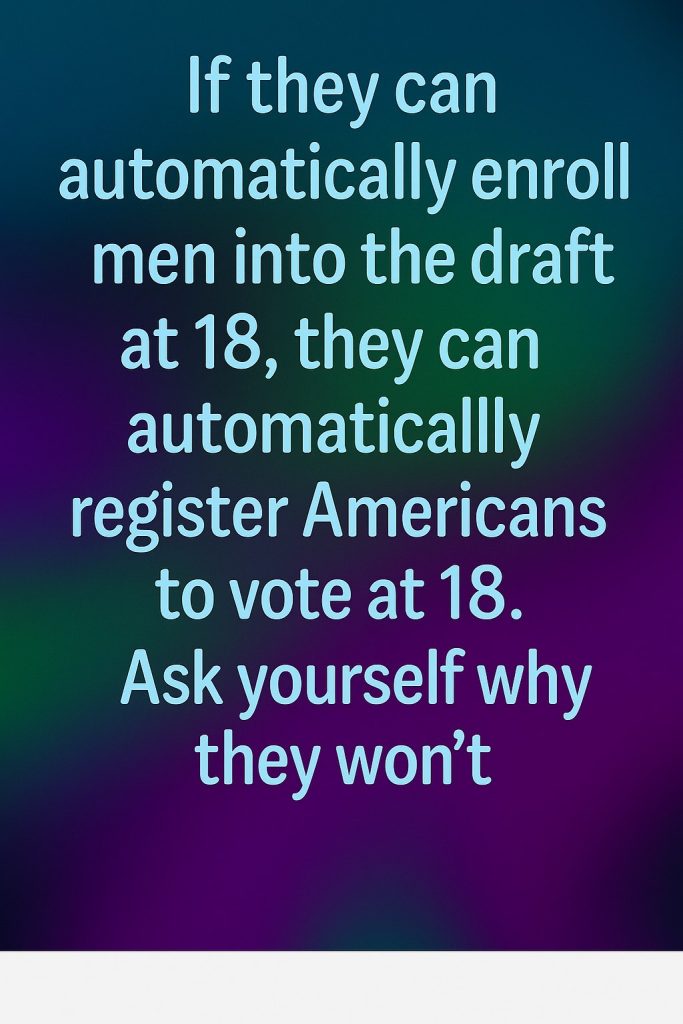
A viral social media post is reigniting a nationwide conversation about voting rights and government policy. The post highlights a striking comparison: “If they can automatically enroll men into the draft at 18, they can automatically register Americans to vote at 18. Ask yourself why they won’t.” This statement has resonated with thousands of users, sparking debate over why automatic voter registration (AVR) remains controversial despite its potential to strengthen democracy.
The United States currently mandates that all male citizens register for the Selective Service System within 30 days of their 18th birthday. This system serves as a contingency in case of a military draft emergency. Importantly, the process is automatic — young men are notified directly, with systems designed to track compliance. On the other hand, voter registration remains a responsibility left largely to the individual, and the rules vary widely by state.
Automatic voter registration, which would register eligible citizens to vote upon interacting with government agencies like the Department of Motor Vehicles, has been proven to increase voter participation. States that have implemented AVR have seen significant boosts in registration rates, especially among young people and historically underrepresented groups.
Despite these benefits, many states still rely on outdated, often confusing voter registration processes. According to a 2022 report from the Brennan Center for Justice, millions of eligible voters remain unregistered or are burdened by cumbersome registration requirements. Automatic registration could alleviate these challenges by streamlining the process and increasing civic participation.
Why has AVR not been universally adopted across the US? Some critics argue that automatic registration could lead to errors or registrations of ineligible voters, though modern data verification systems largely mitigate this. Others claim that the perceived risk of shifting political power dynamics causes resistance among certain lawmakers. The contrast between the automatic Selective Service registration for men and the voluntary, often complicated, voter registration process underscores these tensions.
Additionally, automatic voter registration embodies the principle that voting is a fundamental right, not a privilege. By comparison, registering for the draft is a requirement imposed to protect national security. If the government can automatically sign up young men for potential military service, many argue it should be equally committed to automatically empowering all citizens to vote.
This comparison has energized youth activists, voting rights advocates, and policymakers aiming to reform election laws ahead of the 2024 presidential election. Advocates emphasize the need for uniform policies that ensure voter participation is accessible and equitable nationwide.
Ultimately, the viral social media post succinctly captures a critical question facing American democracy today: If automatic government registration is possible for the draft, why does it remain elusive for voting? The answer likely lies in a complex interplay of political will, institutional inertia, and differing views on civic responsibility. As the nation debates election reforms, the conversation sparked by this simple yet powerful comparison is unlikely to fade anytime soon.
Where to Learn More
- Automatic Voter Registration – Brennan Center for Justice
- What is the Selective Service? – Pew Research Center
- Automatic Voter Registration Faces Political Challenges – NPR
- Voting and Elections Information – USA.gov