A remarkable achievement in calculation and reasoning may have unraveled one of the most intriguing mysteries of our solar system.
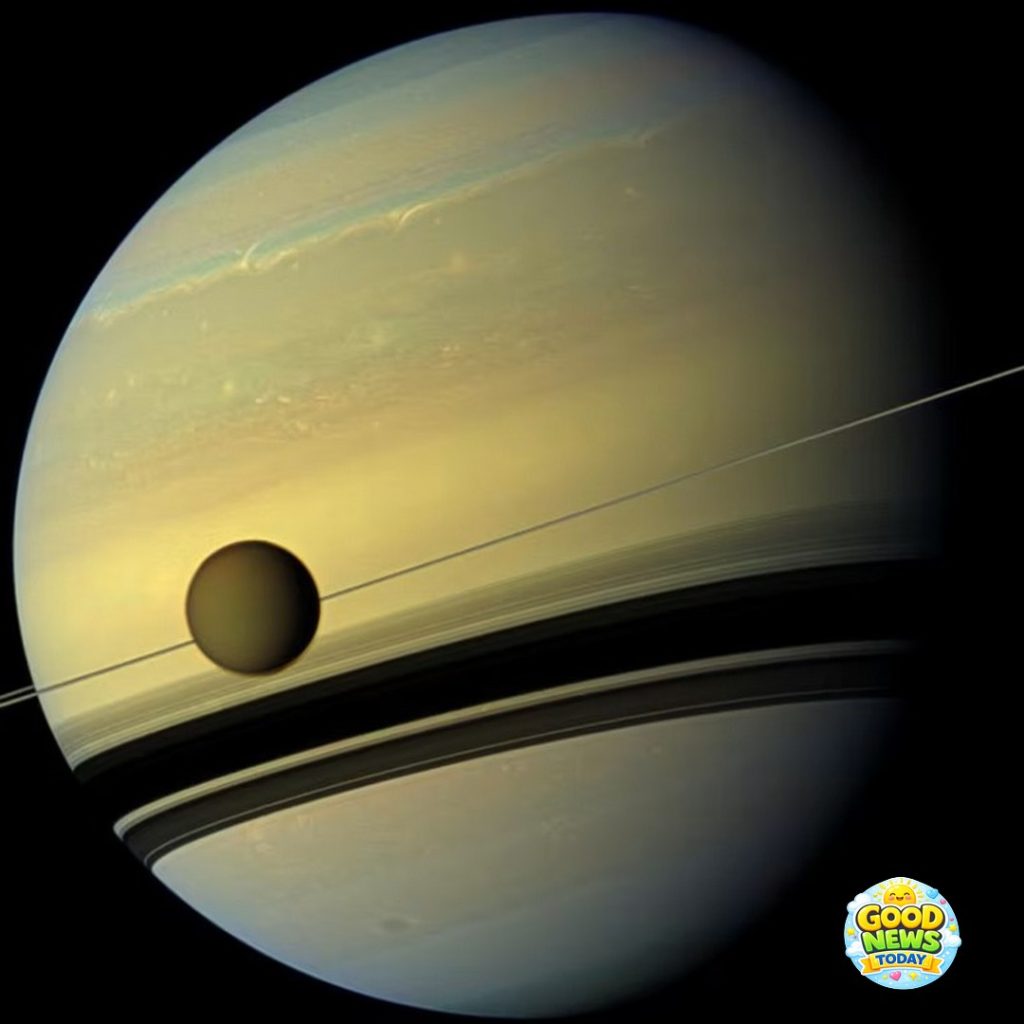
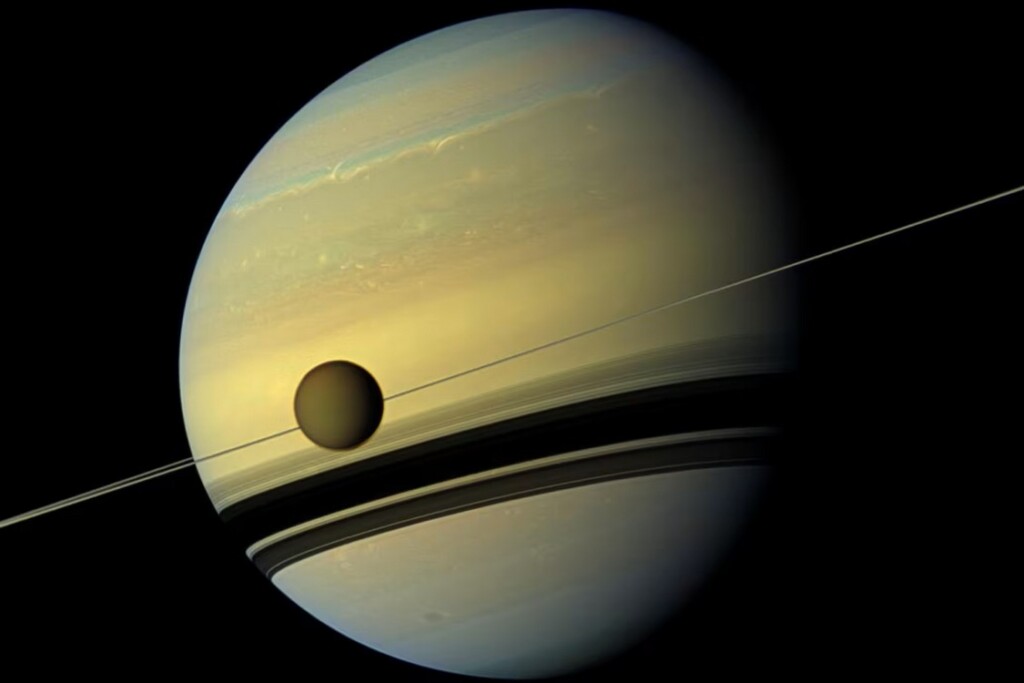
Titan, Saturn’s largest moon, is even larger than Mercury, and despite its prominence, scientists have long been puzzled about how it became so massive that its gravitational pull causes Saturn to tilt and wobble. Saturn is home to approximately 274 moons, making it the second-largest planet in our solar system.
Matija Ćuk, a research scientist at the SETI Institute in Mountain View, California, has proposed a fascinating theory suggesting that a collision with another moon in Saturn’s ancient past could have contributed to Titan’s substantial size. He speculates that this moon may have been a precursor to Hyperion, the largest nonspherical moon of Saturn, though it is significantly smaller than Titan.
Utilizing data gathered from NASA’s Cassini Probe, which explored Saturn from 2004 to 2017, along with new research and computer simulations, Ćuk has introduced a compelling idea: an additional moon colliding with Titan initiated a chain reaction that not only accounts for Titan’s impressive size but also explains Saturn’s unique tilt and wobble, as well as its iconic rings. Ćuk enthusiastically stated that this theory “explains everything.”
As the James Webb Space Telescope continues to expand our understanding of the universe, this discovery highlights just how much more there is to learn about our own cosmic neighborhood.
In his words, “I propose that there was an extra moon about half a billion years ago that collided with Titan, which actually became part of Titan.” This groundbreaking research has been accepted for publication in The Planetary Science Journal. Ćuk further explained, “From this event, Titan could have disturbed some of the inner moons, leading to more collisions that created the rings perhaps 100 million years later.”
Previously, scientists believed that Neptune’s gravitational forces were responsible for Saturn’s wobble, a concept known as “resonance.” However, data from the Cassini mission indicated that the two planets were not in sync enough to support this theory.
In 2022, a different theory emerged proposing that a lost moon named Chrysalis ventured too close to Saturn, disintegrated, and contributed to both its rings and its tilt and wobble. Ćuk refined this idea, noting that Saturn’s wobble was occurring much too rapidly to be solely explained by Neptune’s resonance. By tracing back to the time when Saturn’s rings are thought to have formed, he found that the wobble closely matched Neptune’s gravitational influence.
Introducing an extra moon, about 1,000 times larger than Hyperion, creates a precise resonance between Neptune and Saturn. This means that during the era when both the proto-Hyperion moon and proto-Titan existed, their resonance with Neptune was remarkably aligned with established calculations of how one planet’s orbital force can impact another. However, the collision between these moons accelerated Saturn’s wobble, making the previous Neptune theory seem less likely.