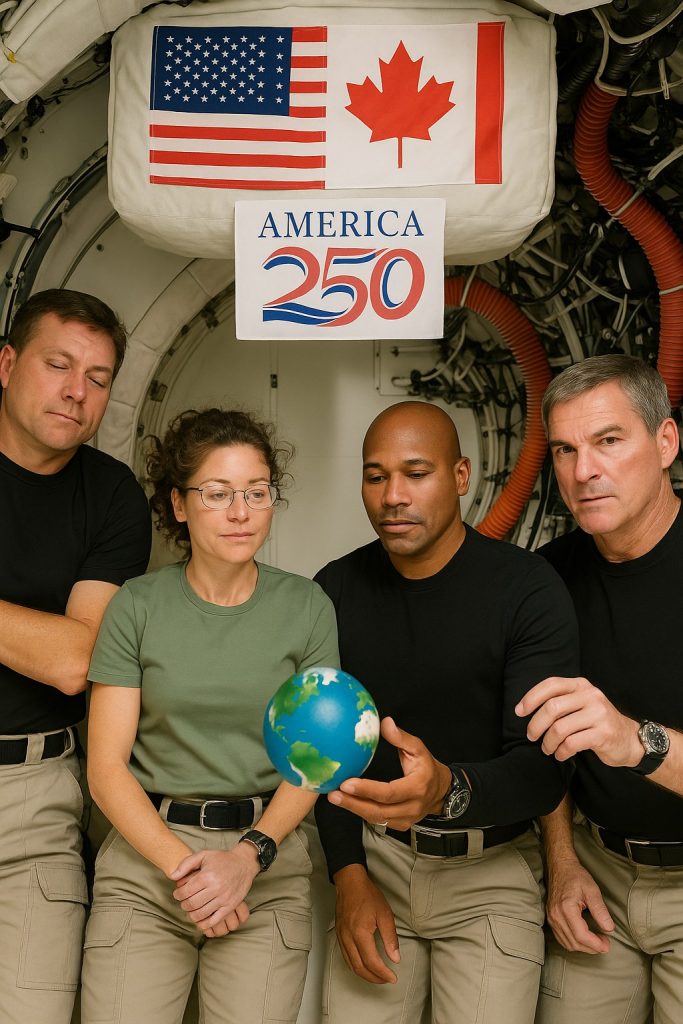
In a groundbreaking moment for space exploration, the Artemis II crew held a live news conference from deep space, captivating audiences worldwide with their first-hand insights from beyond Earth’s orbit. This event marks the first time astronauts have conducted a live media briefing while traveling through cis-lunar space, affirming humanity’s bold new frontier in spaceflight.
The Artemis II mission, NASA’s highly anticipated manned flight beyond the Moon, launched successfully days ago, propelling a crew of four astronauts on a pioneering journey around the lunar vicinity and back. The live news conference, streamed on multiple platforms, provided a unique window into the crew’s experiences, challenges, and excitement as they circle farther from our home planet than any astronauts have in over half a century.
Commander Reid Wiseman, along with fellow crew members Christina H. Koch, Jeremy Hansen, and Victor Glover, spoke candidly about their mission objectives, the sensations of weightlessness, and the technical marvels of NASA’s Orion spacecraft. They described the overwhelming beauty of Earth rising over the Moon’s horizon and how this perspective reinforces the fragile nature of our planet.
“Seeing Earth from this vantage point is awe-inspiring. You appreciate the thin blue layer of atmosphere protecting us, which you never really grasp until you’re so far away,” remarked Wiseman. The crew also touched on the intense preparation and teamwork needed to operate autonomously when millions of miles away from mission control.
Journalists and viewers from around the world peppered the astronauts with questions about their daily routines, scientific experiments onboard, and the psychological effects of deep space travel. Hansen, the Canadian Space Agency astronaut, highlighted the international collaboration underpinning Artemis II, calling it “a symbol of unity and shared human curiosity.”
This mission is a critical step toward NASA’s broader Artemis program goals, which aim to establish a sustainable human presence on the Moon and eventually send astronauts to Mars. The success of Artemis II will validate key technologies and operational practices necessary for long-duration space missions.
Experts monitoring the event noted the exceptional communication systems that allowed the live interaction despite the vast distance, underscoring advancements in space communication technology since the Apollo era.
As the Artemis II spacecraft continues its trajectory, the crew’s positive updates have reignited public enthusiasm for space exploration, inspiring future generations to dream big and look to the stars.
Stay tuned as this historic mission progresses, promising more firsts and breakthroughs from humanity’s new space odyssey.