
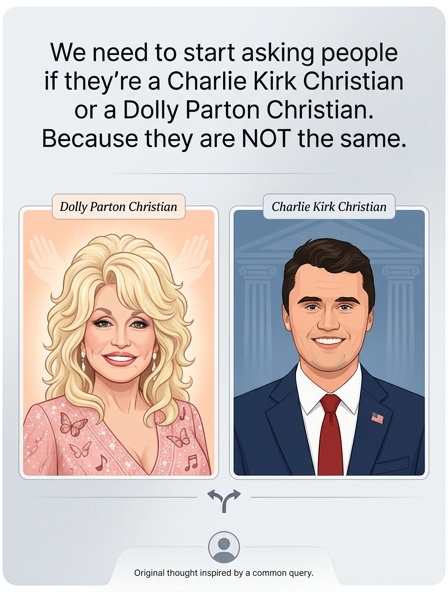
In the digital age, religious identity often becomes a subject of lively debate, especially when contrasting different cultural expressions of faith. Recently, a viral social media post has ignited a conversation about the diversity within Christianity, prompting many to question and differentiate between various ways Christians express their faith.
The post in question, shared by @JamieBonkiewicz, provocatively suggests that not all Christians are alike, asking followers to consider whether they identify as a “Charlie Kirk Christian” or a “Dolly Parton Christian.” This seemingly playful question taps into broader discussions about the cultural and ideological spectra within Christianity in America today.
Charlie Kirk, a well-known conservative political commentator and founder of Turning Point USA, represents a Christian worldview often intertwined with political activism and conservative values. His brand of Christianity aligns with a political stance that emphasizes religious liberty, traditional family values, and an active role for faith in shaping public policy. Those identifying with a “Charlie Kirk Christian” may see their faith as central to their political identity and social engagement, emphasizing American patriotism and conservative principles.
In stark contrast, Dolly Parton, the legendary singer-songwriter and philanthropist, embodies a different kind of Christian expression characterized by warmth, kindness, and a focus on personal faith and community. Known for her Southern roots and gospel-infused music, she often emphasizes love, resilience, and simplicity in her faith. To many, a “Dolly Parton Christian” symbolizes authenticity, humility, and an inclusive approach to spirituality, often celebrated for her charitable work and down-to-earth demeanor.
This distinction has sparked online discussions about whether Christianity can be neatly categorized based on cultural icons or personalities. Many users agree with the sentiment that these labels point to the broader diversity within American Christianity — a spectrum that ranges from politically active, ideologically driven faith to more personal, community-focused spirituality.
Some critics argue that such dichotomies risk oversimplifying complex identities and that faith should not be reduced to pop culture labels. Others see value in recognizing these distinctions as a way to foster understanding among believers from different backgrounds or perspectives. Whatever side of the debate one occupies, the conversation underscores that Christianity today is as multifaceted as ever.
As the viral post suggests, asking individuals whether they align more with a “Charlie Kirk Christian” or a “Dolly Parton Christian” could serve as a conversation starter to better understand personal faith expressions and the cultural dynamics at play. It also highlights that, in America, Christianity is not monolithic but a diverse tapestry woven from various traditions, lifestyles, and values.
Where to Learn More
- Dolly Parton on Faith and Her Spiritual Journey – Rolling Stone
- Understanding Charlie Kirk’s Christian-Political Identity – Politico
- The Diversity of Christianity in America Today – Christianity Today