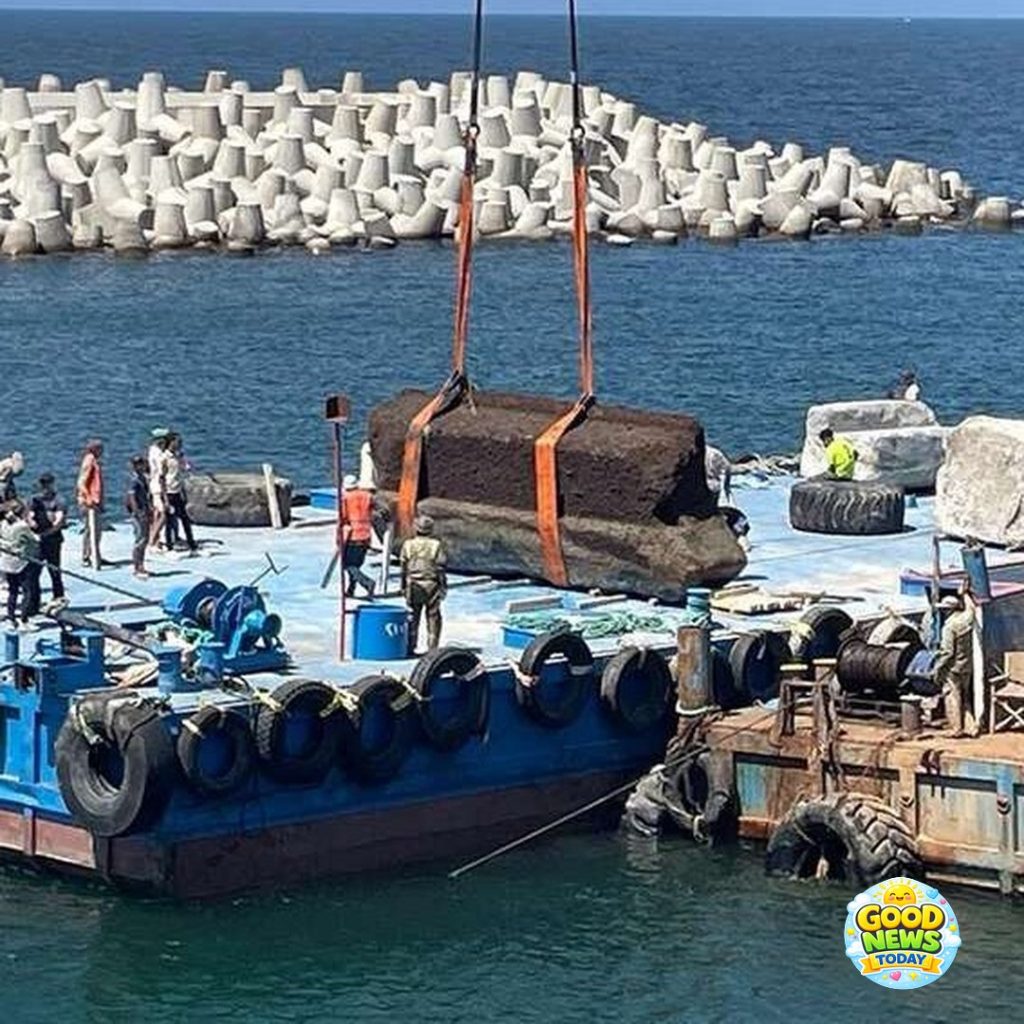
Recently, an incredible discovery was made as 22 massive granite blocks, once part of the Great Lighthouse of Alexandria, were successfully retrieved from the depths of the city’s ancient harbor. Each of these impressive blocks weighed several tons and included upright pillars, frames, and crossbeams, known as lintels, that once graced the entrance of this iconic structure.
Recognized as one of the Seven Wonders of the Ancient World by the Greeks, the lighthouse faced a series of earthquakes in the 10th century CE, leading to its eventual collapse into the harbor. A collaborative effort between France’s National Center for Scientific Research (CNRS) and Egypt’s Center for the Studies of Alexandria (CEAlex) has been underway for over a decade to map and study these remarkable remnants scattered throughout the seabed. A significant analysis conducted in 2014 uncovered approximately 3,000 blocks and an additional 5,000 stone pieces from the lighthouse, spread across a four-acre area.
Each block retrieved was meticulously photographed, and the images were compiled into a photogrammetry database, allowing researchers to examine the blocks in stunning 3-dimensional detail from the comfort of the laboratory. With many blocks analyzed, the CNRS team, spearheaded by Isabelle Hairy, began the exciting process of reimagining the ancient monument piece by piece. Utilizing advanced digital modeling software, they could test how various blocks would fit together with just a click, eliminating the need for heavy machinery. The detailed 3D renders captured fine details like rough and smooth edges, chips, and tool marks, providing crucial insights into how each piece might be positioned.
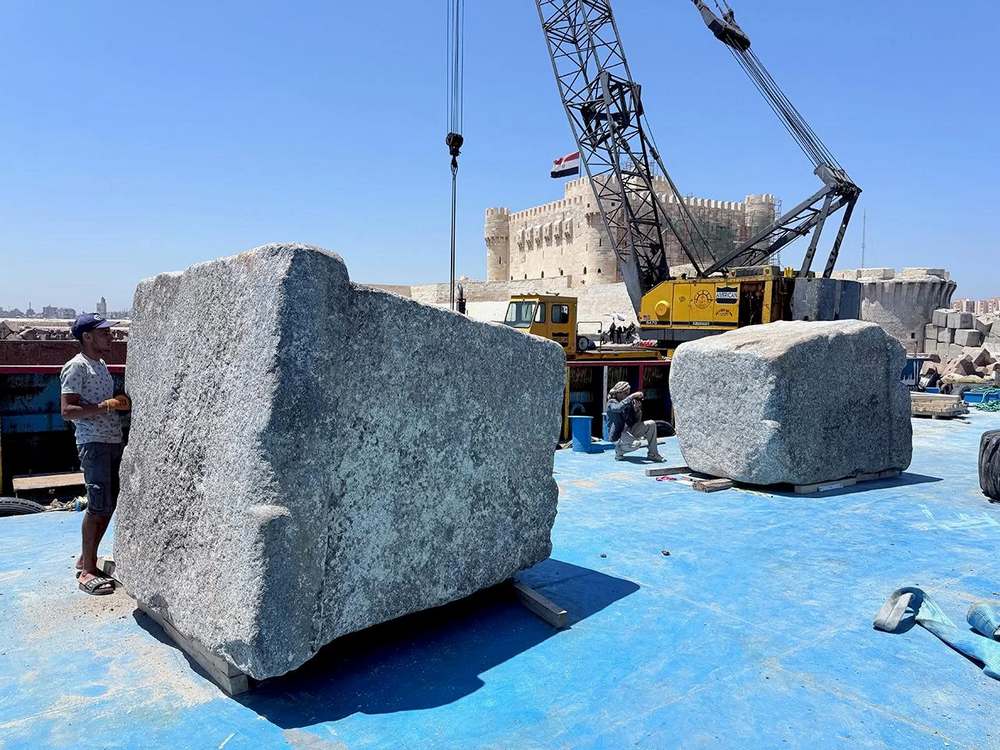
Furthermore, when two segments appeared to align, simulations were run to explore the possible earthquake characteristics—such as intensity and direction—that could have contributed to their dislocation and eventual collapse. The lighthouse, commissioned by Ptolemy, a general under Alexander the Great who claimed rulership of Egypt after Alexander’s empire was divided, served as a beacon for ships entering the harbor of Alexandria for centuries. Its robust construction allowed it to withstand multiple earthquakes over several hundred years before finally succumbing to nature’s forces.
The historical significance of the lighthouse is further emphasized by the words of Ibn Jubayir, a Moorish pilgrim, who attempted to describe this magnificent structure. He expressed his awe at its grandeur, stating that it was built so robustly and soared so high that words failed to capture its essence. He measured one side to be over fifty arms’ lengths and estimated its height at over one hundred and fifty. The interior was equally breathtaking, filled with stairways, entrances, and numerous rooms that could easily confuse any wanderer brave enough to explore its passages.
Among the blocks recovered, several featured Egyptian imagery and iconography, adding yet another layer of historical significance to this remarkable project. As researchers continue to explore and analyze these ancient stones, they not only deepen our understanding of the Great Lighthouse but also celebrate the enduring legacy of one of history’s most extraordinary architectural achievements.