
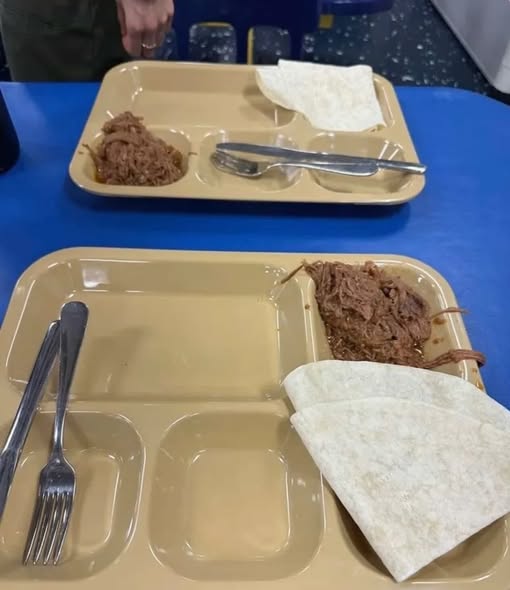
As U.S. troops deployed in the Middle East face a grim reality of starvation and hardship, a stark disparity has emerged, highlighting the contradictions within America’s military spending priorities. Families of sailors aboard ships like the USS Tripoli and the USS Abraham Lincoln have shared distressing photos depicting their loved ones receiving disturbingly sparse and unappetizing meals. The images show lunch trays with little more than a small scoop of shredded meat, a folded tortilla, suspicious grey protein, and portions so minimal that crews are now rationing what they have left.
Compounding the crisis, mail services to military regions have been suspended, leaving families unable to send care packages or provide moral support. Such logistical failures have further dampened morale among service members, who are reportedly enduring not only limited rations but also a troubling communication blackout—and all amid a war that is costing the American taxpayer dearly.
Meanwhile, the costs of the conflict are staggering. According to Harvard policy experts, the war in the Middle East is burning through approximately $2 billion per day during active combat. The Pentagon’s own briefing to Congress estimated the first six days of fighting alone at a jaw-dropping $11.3 billion. By any measure, this is an astronomical sum, making the painful rationing of military meals all the more perplexing.
Ironically, the Pentagon’s public spending habits reveal a different set of priorities. In the fall of 2025, a government watchdog uncovered that Pete Hegseth’s Pentagon approved nearly $7 million in lobster tails, $2 million in Alaskan king crab, and $15 million in ribeye steak — all part of a record-breaking $93.4 billion in end-of-year spending. This extravagant expenditure stands in stark contrast to the meager meals served to deployees on the front lines.
Further highlighting misplaced priorities, the same military budget authorized nearly $100,000 for a Steinway grand piano for an Air Force chief’s residence. It’s a stark reminder that while billions are poured into luxury items for the well-entertained elite, soldiers risking their lives are left to ration tortillas and grey meat.
These conflicting realities shed light on a deeper issue: the discrepancy between spending on lavish amenities for officials and the basic needs of those on the ground. With the U.S. military spending over a trillion dollars on this war, it’s clear that excessive budgets are not the problem— values are.
As questions swirl around this paradox, one thing remains undeniable: the morale and well-being of service members should be a top priority. The image of hungry sailors enduring poor meals while government coffers lavish on opulence underscores a profound need for reevaluation of national priorities—focusing on those who serve rather than luxury for a select few.