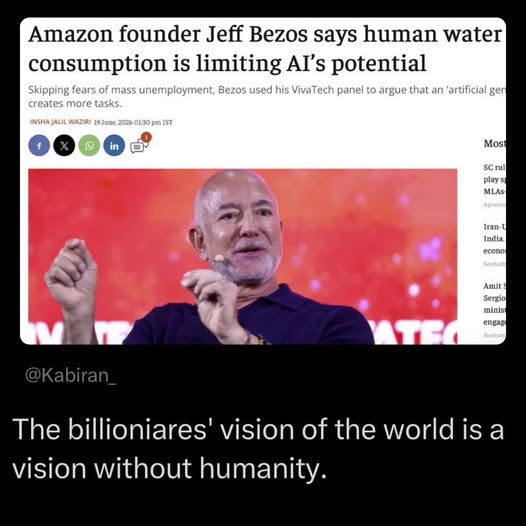
In a recent revealing statement during his speech at VivaTech, Jeff Bezos, the founder of Amazon, raised an unconventional concern about the future of artificial intelligence (AI). While much of the tech world often buzzes about AI’s promise and the potential threat of mass unemployment, Bezos shifted the focus to an often-overlooked resource: water.
“Human water consumption is actually the limiting factor for AI’s full potential,” Bezos explained to an audience captivated by his insights. This provocative claim challenges the typical narrative that AI development is held back by technological or economic barriers. Instead, Bezos suggests that our planet’s dwindling freshwater supplies could be the bottleneck that keeps AI from reaching more advanced capabilities.
The billionaire’s remarks come amidst growing global concerns over water scarcity, with reports indicating that fresh water resources are under severe stress due to climate change, pollution, and overuse. Bezos pointed out that advancements in AI require massive amounts of data processing, energy, and cooling— all of which depend heavily on reliable access to water. Without sufficient water to cool servers and sustain data centers, the development and deployment of increasingly sophisticated AI systems could stall.
This perspective has sparked widespread discussion on social media, with many users praising Bezos for highlighting an often-overlooked environmental factor. A viral image circulated containing the words: “INSHAJ JALIL WAZIRI: Amazon founder Jeff Bezos says human water consumption is limiting AI’s potential.” While some critics initially dismissed the statement as hyperbole, others see it as a wake-up call about the complex interdependencies between technology and natural resources.
Interestingly, Bezos also addressed fears that AI will cause mass unemployment, dismissing this as an overblown concern. Instead, he emphasized that understanding and managing environmental constraints—such as water—are crucial for sustainable AI advancement. During his speech at VivaTech, Bezos highlighted the importance of investing in sustainable infrastructure and innovating water-efficient data centers to ensure that AI can continue to grow without damaging our planet.
This statement aligns with a broader movement among tech leaders to prioritize environmental sustainability in AI and computing infrastructure. As AI applications expand into healthcare, transportation, and climate modeling, ensuring the availability of vital natural resources will be essential for their development and safe deployment.
While some experts debate whether water scarcity alone could truly limit AI growth, Bezos’s emphasis serves as a reminder that technological progress is inextricably linked to environmental stewardship. Moving forward, balancing innovation with resource conservation may determine whether AI will truly realize its vast potential or remain constrained by Earth’s finite natural assets.